

Editor's note: The Eastern Echo staff meets regularly with interesting people on and off campus. Engage in those conversations with us through our weekly Q&A report.
Jack Booth has been involved in student government since he was in high school. Arriving at Eastern Michigan University, he became a senator in his freshman year. Soon, he was serving as vice chair of the Business and Finance Committee. He also served as the EMU Student Government vice president during the 2024-25 school year under former President Hamzah Dajani. He now serves as the Student Government president.
Q: What prompted you to join Student Government as a freshman?
A: When I got here, I really didn't know what I wanted to get involved in. I heard the vice president at the time come speak at an honors kickoff, and it was like, oh, cool, I can definitely do that again. I got involved hoping that somebody would point me in the right direction, and I was placed on the Business and Finance Committee.
Q: What did you learn from your first campaign in Student Government?
A: I learned to really enjoy helping student organizations by giving out money. In my sophomore year, the Business and Finance director at the time approached me about maybe running together for my junior year, and I'd be the vice president. I was like, yeah, I want to take on more leadership roles. In that role, I got to see a lot of the behind-the-scenes of Eastern and how things run, how the money moves, and what I need to do in order to get stuff done. I felt, halfway through that year, that I wanted to continue that opportunity. I saw that we were doing some good things; like, a lot of what we were really trying to focus on last year was trying to remove some barriers to access for students, increasing more funding opportunities ... making sure that we're a force for good, and that, in these behind-closed-door conversations where Student Government is present, someone is there advocating for students. As I got a few other opportunities to continue doing that, I decided I'd run for president.
Q: How did you decide on a running mate?
A: I chose Nina Freeman, my vice president, because she had gotten involved in the Student Government last year, and she was the first senator to get anything done that year in the form of a resolution. I really liked how efficient she was. She was really kind, open and was good at involving other people in projects, and that was someone who I wanted to invest in the same way I had been invested in.
Q: What are your goals for the office?
A: This year, we had campaigned on a few different things. We campaigned on improving the platforms that we had been creating over the past couple years and fostering new interdepartmental relationships, especially when budgets are shrinking. We also try to work with the community a little bit. One of the ways that we're going to be doing that is, we're going to be releasing a sign-up soon for a democracy dinner with some local elected officials to talk about how to get civically involved in your community as a college student.
And then, we've been working to remove some more barriers to entry for students. Like, one thing that we do that's pretty well known is we purchase bus passes for students. We did that again this year to a number that's never been done before. We did about $7,500 worth of passes, which students are able to get on a need-based system. We also pay for the flu vaccine clinics for the uninsured student population. What we try to focus on is how can we remove barriers to entry, make EMU really equitable and inclusive, and improve what's already existing.
Q: What does an average day look like for you, and how do you balance that with your schoolwork, especially as a senior?
A: We definitely have different levels of involvement. Mine and Nina's are probably the highest level. I'm in the office every day because I want to make sure that my directors that I've hired to work for me have all the tools to do their jobs well. I also like that students can know that there's someone they can go talk to every day.
I'm in a lot of different subcommittees, so I do a lot of different things for the university. I sit on the EMU Foundation Board of Trustees, so I go to different trustee meetings. We talk about funding and how to increase donor engagement. I present at the university Board of Regents meetings. I'm on the search committee for the university president, and I'm on the University Budget Committee. So, I do a lot of meetings most days, a lot of personal management and then a lot of emails.
Balancing that with schoolwork, it's difficult. I think that some people have a better work-life balance than I do. I just answer emails or do anything at any time of the day. So, when I see something come in, I might be doing something else, but I'm still going to pull up my phone and answer it really quick. I think Nina is a little bit better at work-life balance, and she knows when to stop answering me, which, good on her, you know, it's just not something I ever developed or that I need to now.
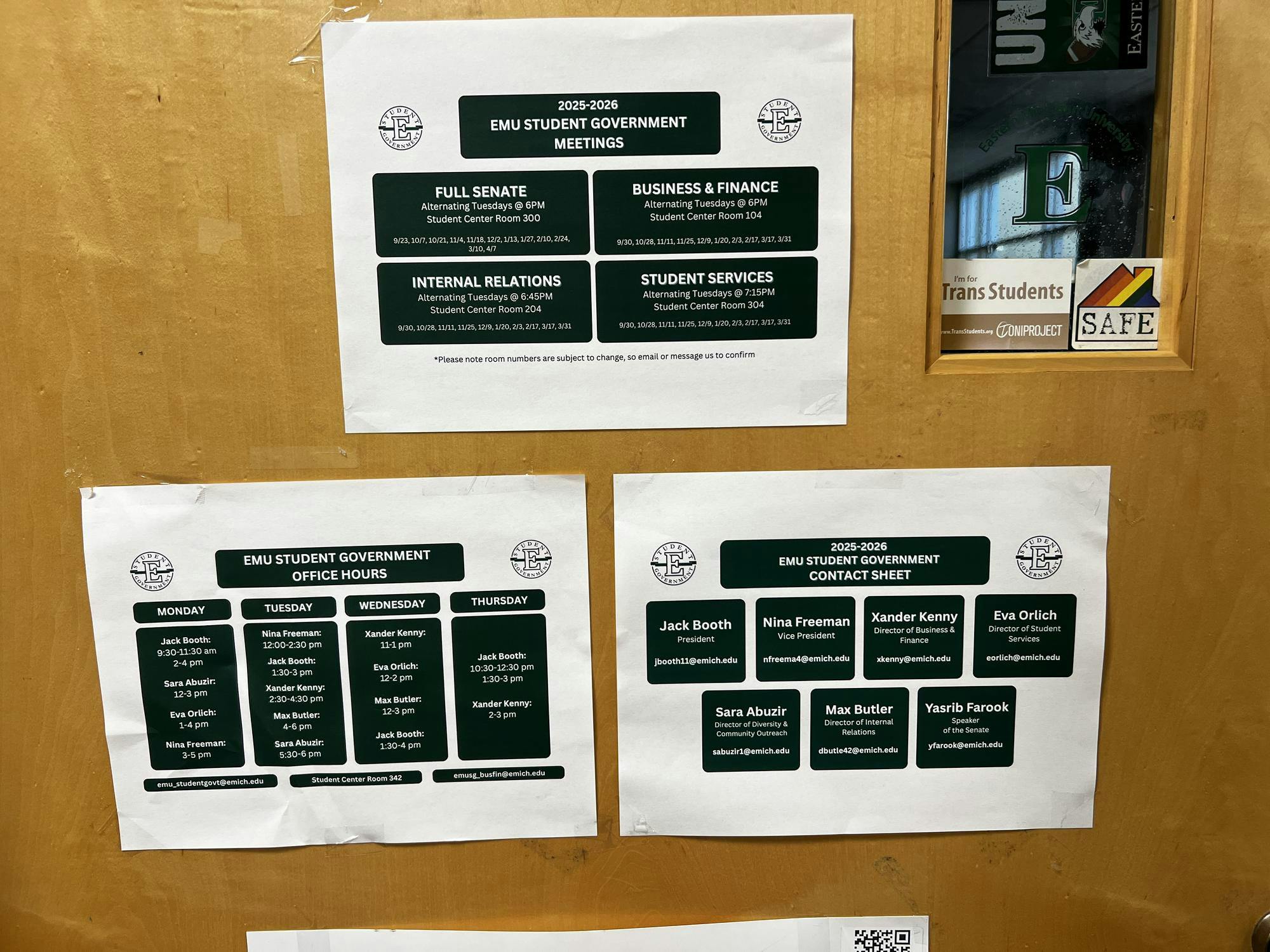
Postings on the door of the Eastern Michigan University student government office, room 342 in the Student Center, provide contact and meeting information.
Q: Did your service in the administration last year provide opportunities to build on the same initiatives, or have you pivoted in some ways?
A: What really helped me, being a part of this last year, was building a lot of connections. So now, when I'm getting into office, I'm not running with a blank slate. One thing we do is we write resolutions. Next month, we're subsidizing a farmer's market so students can get their first five dollars of groceries for free. A lot of people don't understand the back-end stuff for that. I have to reach out to our contact at the Office of the President to release the budget. I've got to talk to dining to purchase the vouchers. It's a lot of facilitating things that I learned last year, which is really helpful. Understanding what we're allowed to fund and what we aren't allowed to fund, so when students are coming in here asking, can we do this for a student organization, I can tell them no. However, I can do something else because I know a lot of the rules really well.
Q: What initiatives did you continue?
We've definitely built off of a lot of what we started to do last year. I think that any good change has to be sustained. I can't do something for a year and then, for example, if Nina decides to run next year, and she goes, oh, we're not going to do any of that, then what we did this year doesn't really matter in the scheme of things. We're still trying to work to remove barriers and make EMU very inclusive and equitable. We're really trying to make sure there's more resources for students. This year, there's a lot of challenges facing students, and we have a really unique position of advocating for them in these closed-room conversations and making sure that the decision makers are keeping in mind students' desires.
Q: Have been any changes, especially with what's been going on regarding federal funding?
A: There have definitely been some small federal grant cuts, not that they affect Student Government personally. We're still waiting on the state appropriations budget for Michigan, which is definitely delaying higher education funding because a lot of people don't know what contributions we're going to get from the state of Michigan at this point.
Across the board, with declining enrollment and everything like that, we have to budget on fewer credit hours. But we're still trying to offer the same amount of resources for students, so that's where the bottleneck really comes in. Every budget decreases, so each year we have to make the hard decisions of what stays and what goes. We're proud to announce that this year, our highest line item that we've ever set in, at least the four years I've been here, was for student organizations and engagement on campus. So even when budgets decreased, we were able to increase our spending there by cutting back on some internal spending. I was able to cut on payroll. Some things like that, like optimizing our budget, have been hard, but we haven't been hit nearly as hard as some other departments. So, we're thankful for that as well.
Q: You mentioned payroll; is that internal payroll for the Student Government?
A: So, I myself, Nina, and then our e-board, they're hired positions. In the spring, when we get a new president and vice president, they put out positions on Handshake, and anyone can apply for them. For example, one of the really important ones is business and finance. Our director there handles a lot of our forms. He's going back and forth with administration, correcting things and making sure people get their money. We reward them for the work that they're doing because it's very much above the work of, like, a senator, who's just saying, yes, let's fund this event.
Q: One of the recent changes on campus is the E|Dining closures. What is your administration's stance on that?
A: I understand it in a two-faceted approach. My first understanding is the same understanding that every student had, which was this very raw, emotional reaction to [it]. We thought we were going to have all of this, and now all of a sudden, two weeks before, we don't. That's a very real and valid reaction to the situation at hand that I wish would have been handled differently. Maybe it could have been, like, next year, this is going to be the change, rather than, we bought meal plans, and now this is the change.
But I also understand the monetary approach of this at the end of the day. Our partners at Chartwells, they're a business; they have to make money. A lot of these places were either barely breaking even, or they weren't. And because we have declining enrollment and not as many people are staying on campus, we're not meeting our contractual obligations to this business. For that reason, I understand why they would have to renegotiate the contract. Because obviously, as a business, as an external partner to Eastern, you can't really operate if you're losing.
So, what I like is that the focus now from administration, E|Dining, and everything that I've seen is not focused on the past. It's like, okay, we're here. How can we make things better a little bit at a time? What I've been seeing now that the focus is on The Commons, is that the executive council is regularly checking in on The Commons during lunchtime, saying, what is the food like that we're serving to students?
Q: Are there ways that Student Government can help?
For a lot of our flex-based users, like our RAs, this can be a little bit difficult because now you can't buy things at the market you're used to. Now, where the Commons is $13, or $11.65, or whatever price is, that's excessive for some students. So, I understand that. And what we're focused on in Student Government is, how can we add on, or how can we make it a little bit better? That's why we're trying to do the farmer's market collaboration. Because with the absence of crossroads, there's not really a place where you can buy fresh produce on campus anymore. So, if we can encourage students or share more about this resource where you can also use your dining dollars and maybe incentivize students to do it by paying for some of it, that's how we hope we can jump in.
Q: What are your biggest priorities in the future? Do you feel like the campus as a whole is going in the right direction?
A: Our priorities are to continue being good stewards of the trust of the student body. I'm going to be in a lot of big meetings this year talking about where our budgets are going, which people we're hiring, and, in that, I'm always representing students. Where other groups might think more about union bargaining or what does this mean for internal organization, what I'm fighting for is, how can we get a person in here whose focus is students? I want to make sure that students are at the center of every decision, whether that's how we're going to allocate our money or what strategies we're going to employ.
Q: Can you provide some examples of what's next?
A: You're going to continue to see how we can make things more equitable. How can we make it more inclusive? One senator is working on including more wash basins in the Student Center, so students who are using our prayer room can properly wash themselves beforehand.
You're going to see us partner with a lot of different on-campus organizations to try to bring back some traditions. One thing that we've discovered in our initial analysis is that there's not a lot of, oh, every year we look forward to this event on campus, and we're really trying to highlight some new ones. You might see us work next semester with the Rec to host a regatta that used to happen in Ford Lake at Eastern and try to get it on campus. We're going to try to have a couple different events that are going to be really keynote, but you'll see a lot of partnerships, a lot of new access for organizations, and students are going to be our main focus.
Q: What do you find exciting about the path ahead?
A: I have been really encouraged in a lot of my meetings this year to hear a lot of high-up people talking about what our focus is. Like, how can we make things better for students? How can we increase retention? What skills do they need to get jobs? What resources do they need to succeed during their time here? One that some of our friends at the Office of Access and Opportunity have been fighting for is e-bill reductions on how much you have to pay down each semester. I think that that would be a great way to keep more students on campus, because more than 50% of our population is Pell Grant eligible. But I believe we have got a lot of good people on the team who are going to continue to steer us in a new direction. I'm really looking forward to seeing what our new university president will have in store for us.
Q: Any hints as to who you may be endorsing for that?
A: I signed an NDA [nondisclosure agreement] on that, so I can't say.
Q: If students want to learn more about Student Government operations, what do you suggest, and how can they watch the Senate meetings?
A: For any student who is interested, I would tell them to go to our website. I'm going to be updating the website a little bit more. All of our contact information is on there. You can send me an email. There's also emu_studentgovt@emich.edu, so you can email that. We'll get back to you. Our meetings are every other Tuesday at 6 p.m. in Room 300 of the Student Center, but sometimes we can't get into that room, so it changes. And then we've got committees on the other weeks. We've got three committees, Business and Finance, Internal Affairs and Student Services, where I'd suggest students attend. They can also drop by our office hours anytime. Room 342 in the Student Center. All of our information is on the door. I'm always happy to meet with the students if they have ideas or if they want to learn more about how to get involved or if they have an idea for us.
Q: What would you like to say directly to the students?
A: We are the unified voice of the student body. We're here to advocate for you, and I'm here for you. So, whatever you need, feel free to reach out. We're happy to help you in any way that we can.
The EMU Student Senate meets at 6 p.m. every other Tuesday in Room 300 of the Student Center starting Aug. 26, 2025. The meeting location is subject to change. For more information, visit the Student Government pages on the university's website.


