

Travel journalist and Fulbright scholar Dan Fellner stops at EMU in December to provide a talk and visual experience for students while sharing perspectives on worldwide cultures.
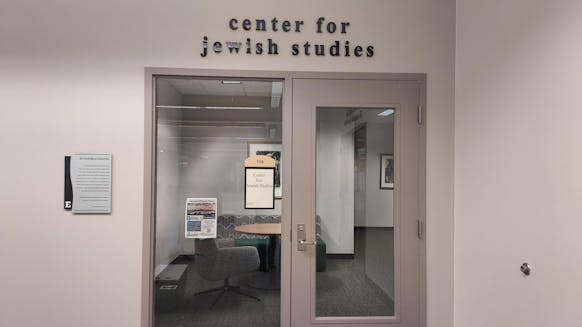
Titled "From Curry to Kreplach," the lecture is part of a series hosted by the EMU Center for Jewish Studies. From a historical perspective, Fellner will look back and reveal Jewish community traditions from around the world during the lecture, which is scheduled from 7-9 p.m. Tuesday, Dec. 2, 2025, in the EMU Student Center Room 310A.
Curry is known as an Indian dish and Kreplach is an Eastern European dumpling that Jews ate. Both dishes were chosen by Fellner as metaphors of the Jewish diaspora. Beyond food metaphors, the presentation-based photo lecture provides images that chronicle the history of Jewish communities, their challenges, their numbers and how they survived.
“The audience gets a better sense of the incredible diversity of Jewish life,” Professor Robert Erlewine said of Fellner's planned presentation. Erlewine is director of the Center for Jewish Studies. He said the center works to bring speakers who can connect with mass audiences.
Beyond great word of mouth, Erlewine said, Fellner brings insights about Jewish communities in parts of the world where it is not widely known that Jews live, such as Curacao, South Africa, Norway, Vietnam and Barbados.
A journalist for 40 years
Fellner, who is married, works as an instructor and has been a journalist for 40 years. Fellner said he has traveled to all 50 states in the U.S. He is also an eighth-time Fulbright fellow.
As a freelance journalist, he has written more than 160 travel articles that were published internationally, including for USA Today, The Jerusalem Post, The Washington Post and The Arizona Republic.
A storytelling career
Majoring in journalism, Fellner graduated from Ohio State University. His early career began in television news, covering news and sports. Then, he joined the faculty at Arizona State University, the School of Journalism, in 1998, teaching undergrads until retirement.
Nowadays, Fellner teaches lifelong learning courses, and gives lectures at schools and universities as a travel journalist.
“I've always had a passion for travel and telling stories about interesting places,” Fellner said.
Preparing for challenges
As a storyteller who wanted to write about hidden gems, Fellner narrowed his interest into geographic locations and then personas. He said his main interests involve culture and popular trends. By locating a country or a city around the world, he looks for icons or people he might find and write about, such as Paul Cohen, a Jew who has lived in Greenland for 23 years.
“It's so much easier now than it used to be, because when I first started, there really wasn't the internet,” Fellner said, explaining how he once spent hours going to the library to read about places.
Now, Fellner does his preparation online, reading about the history of locations, contacting people and scheduling interviews in advance.
Fellner said he must plan his trips prior to his travels due to the increase in security measures. Safety has become an important issue, he said, especially for synagogues and Jewish community centers overseas.
“If you show up unannounced, there's a good chance you're not going to be able to get in,” Fellner said.
His tip for travelers, especially journalists who travel, is to always have that passport handy.
Finding stories
Greenland
Fellner found Cohen in Greenland, after searching for a non-touristic place to write about. He found a small town called Narsac, where he discovered Cohen was likely the only Jew on the island.
“He welcomed me into his home and told me the story of how a Jew from Wisconsin in the United States had built a new life for himself, working as an interpreter in this small fishing town on the southeast coast of Greenland,” Fellner said.
Elvis the king was a mensch
As part of Fellner's work with the Arizona Republic, he traveled to Tupelo, Mississippi. In a local museum, he saw a Hanukkah menorah, a Jewish symbol. The museum director explained the menorah belonged to Elvis Presley and referred Fellner to a small Tupelo synagogue to find more information. Fellner met the person who, as a kid, gave this menorah to Presley. In Tupelo, Fellner discovered the Presley’s Jewish roots on his mother's side of the family.
One of Fellner’s travel lectures is called “Elvis the King Was a Mensch.” The lecturer was inspired to share the less-popular story of the music artist.
“People are interested in pop culture and who our heroes are, and when Jews find out that maybe their heroes have a connection to Judaism, it's something we enjoy,” Fellner said.
Film sites
One of the places Fellner likes to visit are the sites were movies were filmed.
“I like writing about some of the movies that I've enjoyed watching growing up, and actually going to the places," he said.
“The Birds,” which was filmed in Bodega Bay in California, is one of those examples. Fellner also traveled to the island of Martha's Vineyard, where the movie “Jaws” was filmed. He visited Berkeley, California, where parts of the movie "The Graduate” were filmed. He has even traveled to locations where James Bond movies were filmed, in Monte Carlo and Thailand.
From Judea to India
Also among the stops Fellner has made is the city of Kochi, in India. In the era of 562 BCE, Fellner said a Jewish group was seeking economic opportunities when moving from the Middle East to India and finding a home in what was then called Cochin, along India's Malabar Coast. They were primarily spice dealers, Fellner said. A section of that area is still called “Jew Town," because it was inhabited by Jewish spice traders.
Fellner said that in Mumbai, another big city in India, there are several functioning synagogues, which are maintained by one of the oldest Indian-Jewish communities, B'nai Israel. Fellner said they were hugely important in building the Indian film industry, which is known as Bollywood.
Dream travel destinations
With the repertoire of places Fellner has visited in the past, he still dreams of seeing new places. Nepal, said the journalist traveler, held the largest Passover Seder anywhere in the world several years ago. Also, countries in Central Asia, like Uzbekistan, have fascinating and rich histories.
Tips for beginner journalists
Fellner offered some tips for journalists getting started.
He advised working at the university’s newspaper to gain experience, but not stopping there.
Get as much experience as possible just writing, Fellner said, including writing for traditional newspapers, websites, blogs, magazines and even a podcast. He encouraged journalists to learn to tell stories in all the different ways that are available.
“Just do it. Do it all you can," Fellner said, warning writers against waiting for the one golden ticket.
Taking classes seriously was another piece of advice he offered. Student journalists should care about the learning process and study ways to craft stories, rather than worrying only about grades.
Fellner said students should use all the resources available to them, including calling on professors and their expertise for guidance.
And when it comes to the interviews, he said, always allow the subject to share by asking if there’s anything to add.
Additional information
Between October and January, the EMU Center for Jewish Studies hosts three speakers’ events, the last one occurred Oct. 27, 2025, led by Elan Golod who told the story of Jewish Syrian migration during World War II. The last lecture in the series will be delivered by author and conspiracy expert Mike Rothschild. His lecture, titled "Space Lasers and Conspiracies," is scheduled for Jan. 26, 2026.
The lecture "From Curry to Kreplach" is free and open to the public.
EMU students who are interested in the lecture can earn learning beyond the classroom credit for attendance.


