

As the State of Michigan continues to grapple with decreased enrollment in higher education, Eastern Michigan University is responding to the challenge with a strategic plan to address the decline.
For 2009-2010, EMU saw a total annual student enrollment of 28,067, the Integrated Postsecondary Education Data System reported. By 2023-2024, that number was down to 16,093.
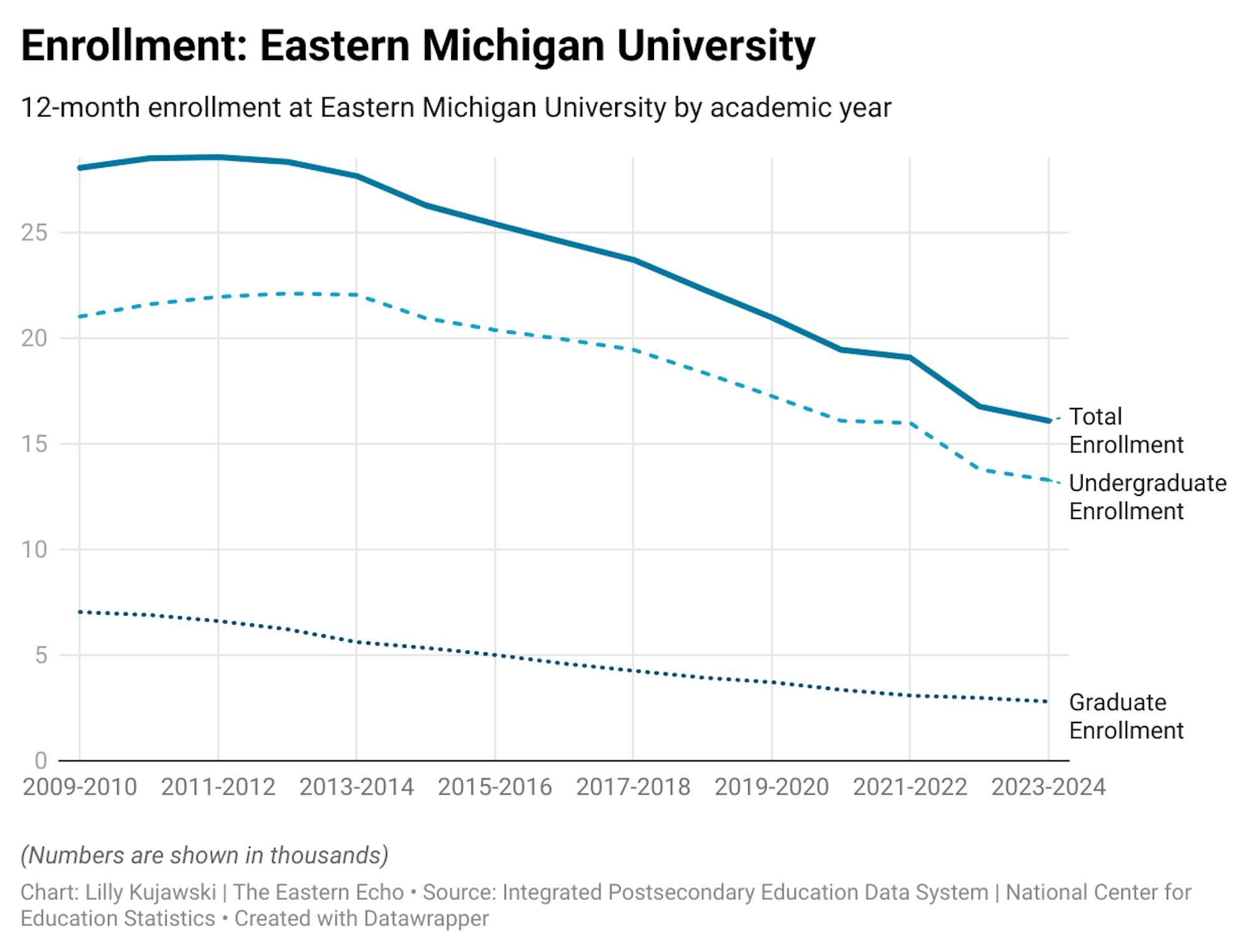
Total enrollment at Eastern Michigan University has seen a decrease over time.
The total enrollment for the fall 2025 semester was 12,176 students, as of Nov. 20, 2025, said Katie Condon, vice president of enrollment management at the university. This fall, year-over-year freshmen enrollment decreased by 18.8% at EMU compared to last fall, dropping from 1,607 to 1,305 as of Nov. 20, 2025, Condon said.
Demographic quest
Addressing the enrollment decline first requires understanding why it is happening. There are a number of determinants behind decreasing enrollment, Condon said. Significantly, a declining birth rate in the United States is a driving factor, pulling down the number of expected high school graduates with it, the Western Interstate Commission for Higher Education reported. This is referred to as a demographic quest, Condon said, and may also be described as a demographic cliff.
"One of the reasons we're seeing a decline in enrollment is due to the declining population of high school graduates in the state of Michigan, so there's less people to pursue higher education because of lower population in the state," Condon said. "The population of the United States is decreasing overall, but you see some states — Florida, Texas and other places — that are seeing some population increases, so it's not a broad-based stroke, but certainly in Michigan, the declines are pretty dramatic."
Nationally, the number of high school graduates will see a peak this year, before a steady decline through 2041, as 2026 marks 18 years since the Great Recession, which contributed to the drop in birth rates, WICHE reported. In Michigan, the 2000 crude birth rate was 13.7 live births per population of 1,000; by 2023, it was 9.9. per 1,000 people, reported data from the state and U.S. Census information.
WICHE projected that Michigan will see a decrease of 20% in high school graduate populations by 2041 — the second biggest decline in the Midwest region.
Enrollment decline at EMU follows a statewide pattern. In 2009-2010, there were 945,354 students enrolled in Michigan higher education institutions, IPEDS reported. In 2023-2024, there were 608,170.
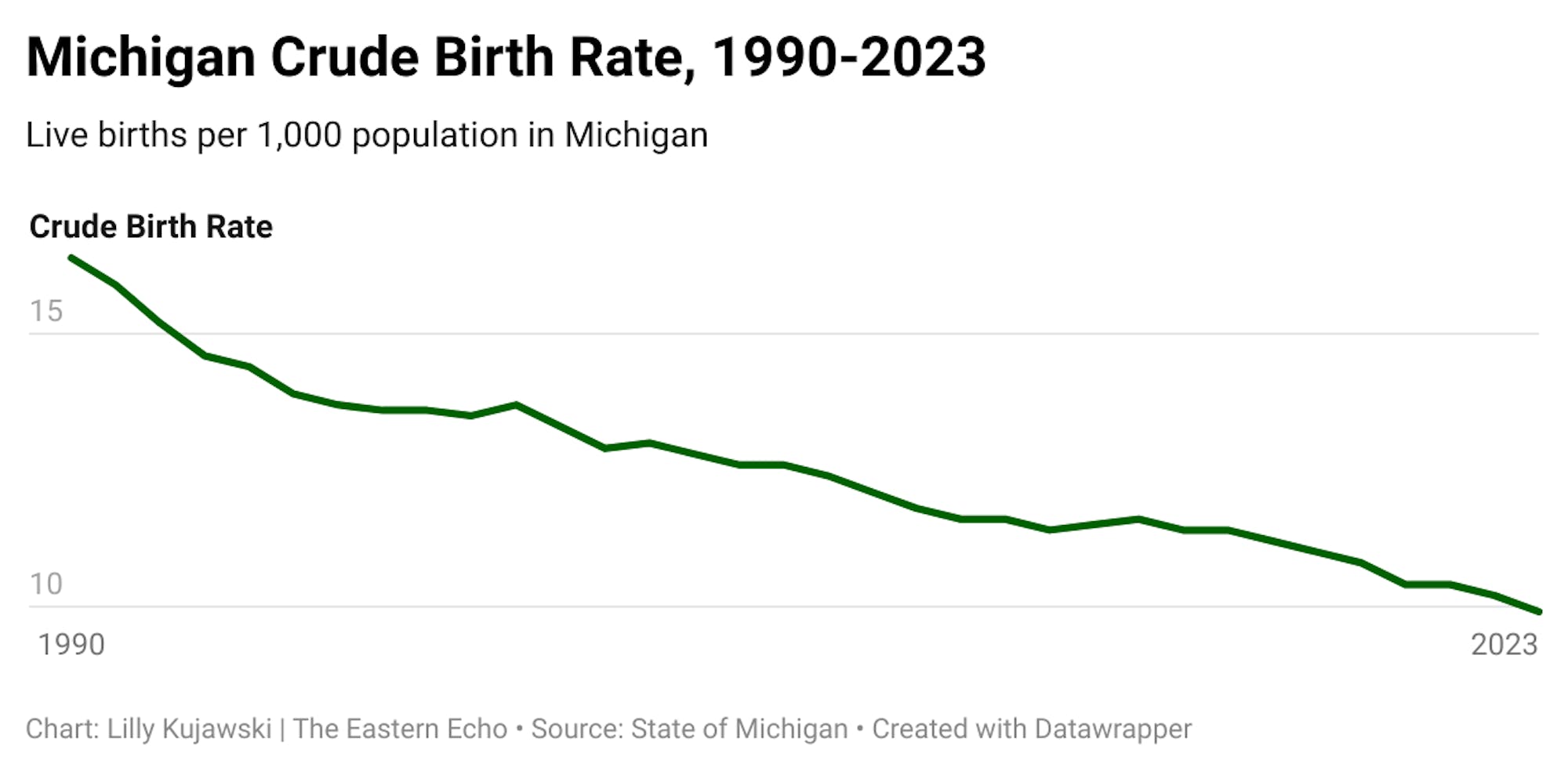
Live births per population of 1,000 in Michigan from 1990 to 2023.
Increased competition
EMU is also up against other higher education institutions in the state, Condon said. With state incentives like the Michigan Achievement Scholarship, which guarantees free community college tuition to recent eligible high school graduates, more students may choose to attend a 2-year college out of high school.
EMU offers features and resources to attract transfer students of all kinds, including those coming from a two-year college, Condon said. For example, EMU offers more transfer articulation agreements than any other institution in Michigan, she said. The university has also added an additional admissions counselor specifically for transfer students and increased the transfer student scholarship it offers.
Flagship universities, such as the University of Michigan and Michigan State University, face their own enrollment challenges, including international student enrollment, Condon said. Because of this, these universities can admit more students, when historically they might have been more selective, she said.
Nationally, universities saw a decrease of 17% in new international student enrollment this fall, a report from the Institute of International Education said, with 57% of higher education institutions noticing a decrease. For universities like U-M and MSU, the out-of-state tuition that international students pay can be a significant source of revenue. Financially speaking, it could take two to three in-state students to make up for the lost tuition of one international student, Condon said. With increased acceptance rates expected at these universities, fewer students may opt for institutions like EMU, she said.
More students who were admitted to EMU ultimately chose to attend MSU than have previously, with 1,800 students taking that route last year, Condon said.
College-going rates
The rate in which people in Michigan seek and complete a degree is also a factor in higher education enrollment, Condon said. In 2019, Gov. Gretchen Whitmer announced an initiative called Sixty to 30 to increase the number of working-age adults in Michigan who have a college degree or certificate from 51.8% to 60%. Michigan is behind the national average of 54.9%.
The initiative includes funding support to help Michiganders pay for tuition, including the Michigan Reconnect program, which provides free community college tuition for Michigan residents 25 and older with no college degree.
In Ypsilanti, 45.8% of residents age 25 or older have a bachelor's degree or higher during the 2019-2023 period, reported Health For All Washtenaw. This places Ypsilanti in the top 50% for Michigan and U.S. census places but behind the overall Washtenaw County percentage of 58.1%.
Rising to the decline
In October, EMU's 5-year inaugural strategic enrollment management plan was approved, with steps and goals for the university to focus on through 2026-2031, Condon said.
"We did over 150 listening sessions with folks across campus, including faculty, staff and a number of student groups in order to create this plan," Condon said. "The plan has six goals and a variety of different strategies to help reach those goals."
Overall, the focus of the plan is to stabilize enrollment, Condon said. Currently, the university is working to create a website for the strategic plan, which the campus community will have access to, she said.
"It's a multifaceted plan that is both about increasing the access for students, as well as increasing pathways for students to find an educational pathway at Eastern," Condon said.
This means looking at the traditional freshmen cohort and strengthening EMU's position as an institution where students want to pursue a traditional four-year education, Condon said. It also means increasing retention rates at EMU, so the university not only attracts new students but also keeps them.
"Being successful in college is a very important factor in making sure that students can go on and get the careers that they want to," she said. "I always say that the most expensive college degree that a student will pursue is the one that they don't graduate with — when you take out a loan, but then you don't have the degree at the end, and so we have to make sure that as many students as possible are able to complete their degree."
The university has graduation rate goals for its student body and is working to make sure it offers the wrap-around services students need in order to graduate, Condon said. Another goal for EMU is to increase the experiential learning opportunities available, so students have the chance to learn in and outside of the classroom, creating more competitive candidates in the job market post-graduation, she said.
Next is a goal that Condon described as student attachment, which is meant to bring a sense of belonging and instill students' pride in EMU. The hope is for that sense of school pride to result in students encouraging others, such as friends and coworkers, to pursue a degree at Eastern as well.
Statewide support
The Michigan Achievement Scholarship, which went into effect beginning with the high school class of 2023, provides up to $27,500 over five years, up to $5,500 per year, for eligible recent high school graduates to put towards tuition. Students must fill out the Free Application for Federal Student Aid to apply, and for university students attending a four-year school, the scholarship is awarded based on financial need.
"Eastern would love to see additional opportunities for students to get statewide scholarships, like the Michigan Achievement Scholarship — perhaps an expanded scholarship available or increasing the funding for that scholarship so that more students are eligible for that scholarship, and so that's one thing we advocate for," Condon said.
While a reported seven out of 10 four-year university students are eligible for the Michigan Achievement Scholarship, Condon said she'd like to see increased eligibility for the scholarship so more EMU students can access the tuition support.
"We're very, very thankful for it, but we would love to see some additional benefits for students," Condon said.
As of August 2025, a total of 1,721 EMU students have been awarded funding from the Michigan Achievement Scholarship, the scholarship data dashboard showed. The average amount awarded for EMU students was $5,109.53.


