

This academic year, the Department of Africology and African American Studies is celebrating its 50th anniversary.
In 1975, Eastern Michigan University established a program for African American Studies as a minor. The program was later established as a department, which is an important distinction on the university level, said Peter Blackmer, an associate professor of Africology and African American Studies at EMU.
In 1990, EMU became the first university in Michigan to offer a bachelor's degree in Africology and African American Studies and in 2018, became the first university in Michigan to offer it as a master's degree.
In celebration of the milestones and history of the department, Blackmer and students curated a gallery in Halle Library that will be open through Feb 28, 2026. Some of the students that helped curate the gallery include Ramses Leon, Cheaney Ferguson and Victoria Huguley. The exhibit is called "Study & Struggle: 50 Years of African American Studies at EMU." The gallery is open during Halle Library’s regular hours.
Halle Library is open 1 p.m. to 10 p.m. on Sundays, 7:30 a.m. to 10 p.m. Monday-Thursday, 7:30 a.m. to 5 p.m. on Fridays and 9 a.m. to 6 p.m. on Saturdays. The reception for the gallery was held Tuesday, Feb 10, 2026.
“The department of Africology and African American Studies at Eastern has a history that I don't think a lot of people are familiar with. The exhibit is designed to introduce students, faculty members, community members to what it has taken over the last 50 years to create, expand, and sustain the department of Africology and African American Studies,” Blackmer said.
The exhibit features photographs, videos, typed documents and oral histories. The oral histories are there so visitors can hear from some of the people featured in the exhibit in their own words and their own telling of the histories they're a part of.
“In particular, some of the documents from the Black Student Union around 1969, there's one that says ‘What we want, what we need’, and when you read through that particular statement, it’s playing out some of the philosophies and bigger visions and demands of the Black Student Association. When you read that in the context of the era you can see very clearly some of the influences of the Black Panther party on the language, on the politics, on the ideologies, and so finding that document really showed to me and to Ramses some of the ways the black power era was specifically impacting and influencing students organizing at Eastern in the late 1960s,” Blackmer said.
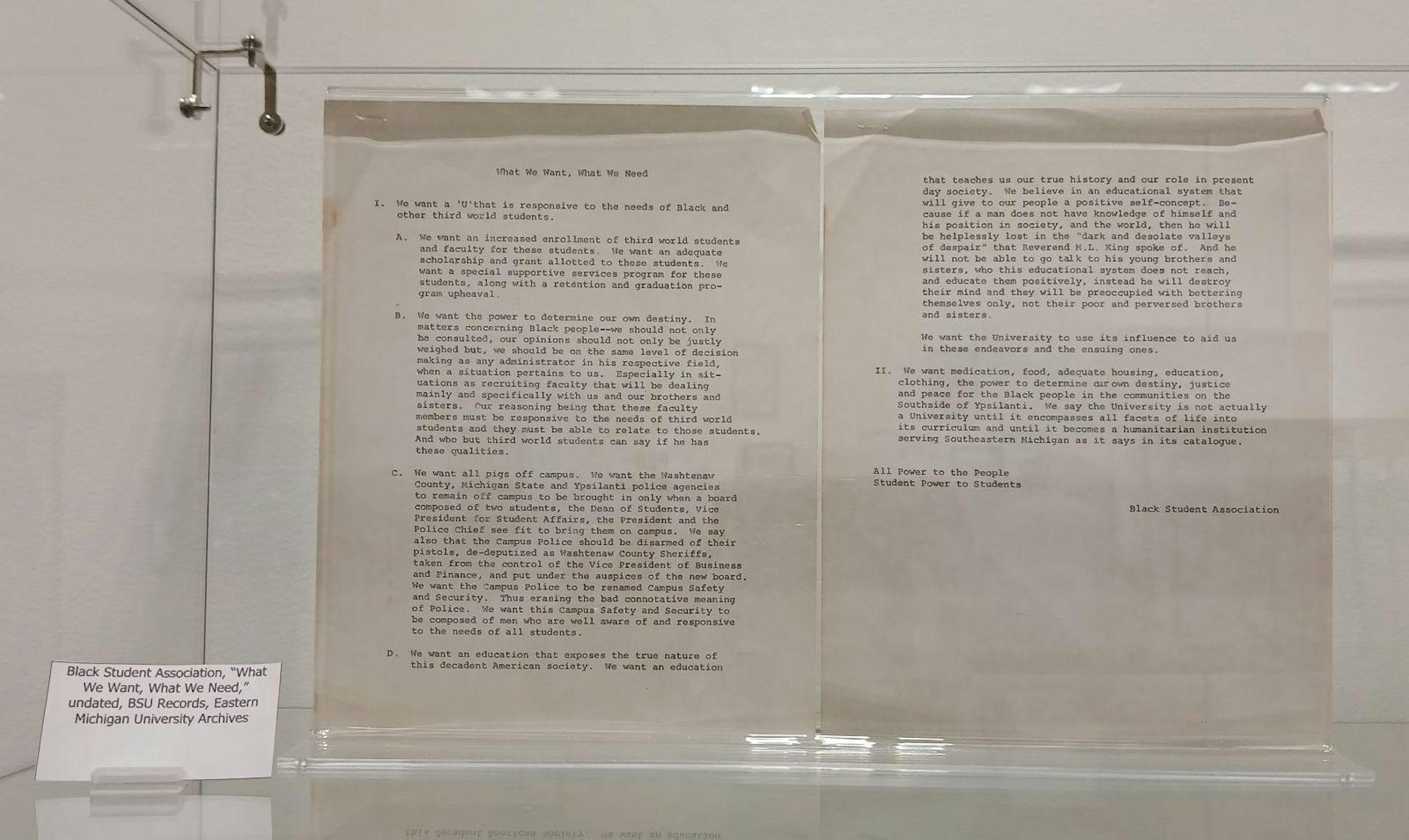
"What We Want, What We Need" document states philosophies, visions, and demands of the Black Student Union at EMU from 1969.
Leon, a double major in Africology and African American Studies and political science, worked with Blackmer over the summer to curate the first part of the exhibit. They went through the archival collections relating to the Black Student Union and campus demonstration records and picked ones that best told the story.
“We started off by going through the archives and figuring out two questions: What's the story we’re trying to tell, and how do we tell that story? Once we figured out which story we wanted to tell, we had to figure out how we wanted to tell that story. So we tried to be intentional in curating materials in the exhibit that really tell the story of the role of student activists, faculty members, and community members in planning to create and to grow the department of Africology and African American Studies. So in there you’ll see a lot of typed documents from flyers, to meeting minutes, to statements of demand, so that visitors can get a better sense of the things that student activists were fighting for in different areas,” Blackmer said.
Ferguson, an Africology and African American Studies major, helped to curate the final section by reaching out to alumni and getting interviews with them to learn about the significance and importance of African American Studies today.
Huguley, an Africology and African American Studies major, worked on the section that shows more recent student protests and movements. They focused on the 2016 Black Student Union protest against campus racism. That protest was one of the contributing factors to EMU first offering a master's degree in Africology and African American Studies in 2018.


