Hannah and Ella Schultz, twins from Billings, Montana, came to Eastern Michigan University because it fit their price range. Once they started as students, they discovered that they were paying the same price as everyone else.
In the 2020-21 school year, 96% of colleges nationally still charged out-of-state tuition, and Michigan was one of seven states that had at least one institution offering the same charge for in-state and out-of-state tuition, the Midwestern Higher Education Compact reported. In 2016, EMU chose to drop an out-of-state charge for undergraduate students from any state, and in 2018, the same was applied to international undergraduate students. The university made this change for fairness and as a recruiting tool, Walter Kraft, the vice president of communications at EMU, said.
He said it connects to the university's motto: all are welcome here.
“So, we will keep on being a very welcoming and open university that encourages people from all backgrounds,” Kraft said. “Whether geographic or whatever their background might be, whether they are international or out-of-state or local or urban or rural or you name it. That we welcome students from wherever they come from, and whatever their background.”
With the loss of revenue in fees from nonresident students, the university hoped that nonresident student enrollment would increase to cover the difference, Kraft said.
The results
From fall 2014 to fall 2025, the number of students from places other than Michigan has stayed around 11-14% of total enrollment, including both undergraduate and graduate students.
Fall 2023 was the outlier in the data with 15% enrollment of students not residing in Michigan, calculated from the EMU 2023 Data Book.
In the 11-year period between 2014 and 2025, the lowest enrollment of non-Michigan residents was in 2019 with approximately 11.5%, calculated from the EMU 2019 Data Book.
In fall 2014, there were roughly 2,900 students enrolled from outside of Michigan. Total enrollment for that year was 22,261, the EMU 2014 Data Book reported.
Approximately 1,700 students from outside of Michigan attended EMU in fall 2025; however, there were only 12,176 total students enrolled, the EMU 2025 Data Book reported.
Though enrollment has decreased in the past 11 years, the percentage of students enrolled whose residence is outside Michigan has stayed relatively the same.
Clarissa Russell has worked with out-of-state students in the EMU admissions office since 2007, first as the regional recruitment manager and then as the associate director of regional recruitment and outreach since fall 2023. She said that she has seen a significant number of students from Ohio, Florida, Illinois and Indiana.
Why out-of-state tuition is charged
Historically, out-of-state tuition was designed to cover the cost of those students' parents not paying taxes to the state of the institution. State taxes help fund public higher education institutions.
Even when students attend out-of-state schools, parents pay taxes to their home state.
“Regarding the impact on institutions, research has shown that increasing out-of-state tuition and nonresident enrollments can be a viable revenue-maximizing strategy, though the expected revenue gains from out-of-state students do not always translate into a net increase in tuition revenue,” the Midwestern Higher Education Compact states.
Ways schools can entice students
While EMU chose a flat undergraduate tuition rate to draw in nonresident students, there are other choices schools can make.
“Removing as many barriers as possible, particularly when it comes to application fees, testing requirements — honestly trying to make it easier to get into, and then when it comes to tuition, lowering rates or offering similar tuition rates as to in-state schools would be helpful," said Kaitlin Sandrock, a guidance counselor at Port Clinton High School in Port Clinton, Ohio.
Sandy Baum, a senior fellow in the Center on Education Data and Policy at the Urban Institute and author of multiple books on higher education, recommended targeted financial aid.
“Many students don’t have the money, and if you give them financial aid, then they’ll come, but some students do have the money,” Baum said. “So giving them the money, lowering the price for them — that's money that you could use to draw in somebody who couldn’t otherwise afford it.”
Reciprocity agreements allow students to attend out-of-state schools at discounted rates, sometimes matching in-state tuition. There are regional agreements as well as ones between specific neighboring states.
The four major regional exchanges include the Academic Common Market, Midwest Student Exchange Program, Tuition Break and Western Undergraduate Exchange, the Midwestern Higher Education Compact states. Michigan was a part of the Midwest Student Exchange Program until it went into inactive status in fall of 2019.
In 1978, EMU began a reciprocity agreement with Ohio that allowed Ohio students to attend at the in-state price. Former EMU President James Brickley said at the March 15, 1978 Board of Regents meeting that the agreement would be advantageous as a recruiting tool and that Ohio students would be likely to be full-time students and live on campus.
High school students have many options to choose from when they graduate. If they decide to look at a four-year institution, Sandrock said, she has noticed that students look at size, majors offered, class size and the number of activities on campus.
Chloe Fouts, a senior at Port Clinton High School in Port Clinton, Ohio, said that she plans to attend Terra State Community College for cybersecurity next year. When looking at colleges, Fouts found how close the school was and tuition to be important decision-making factors.
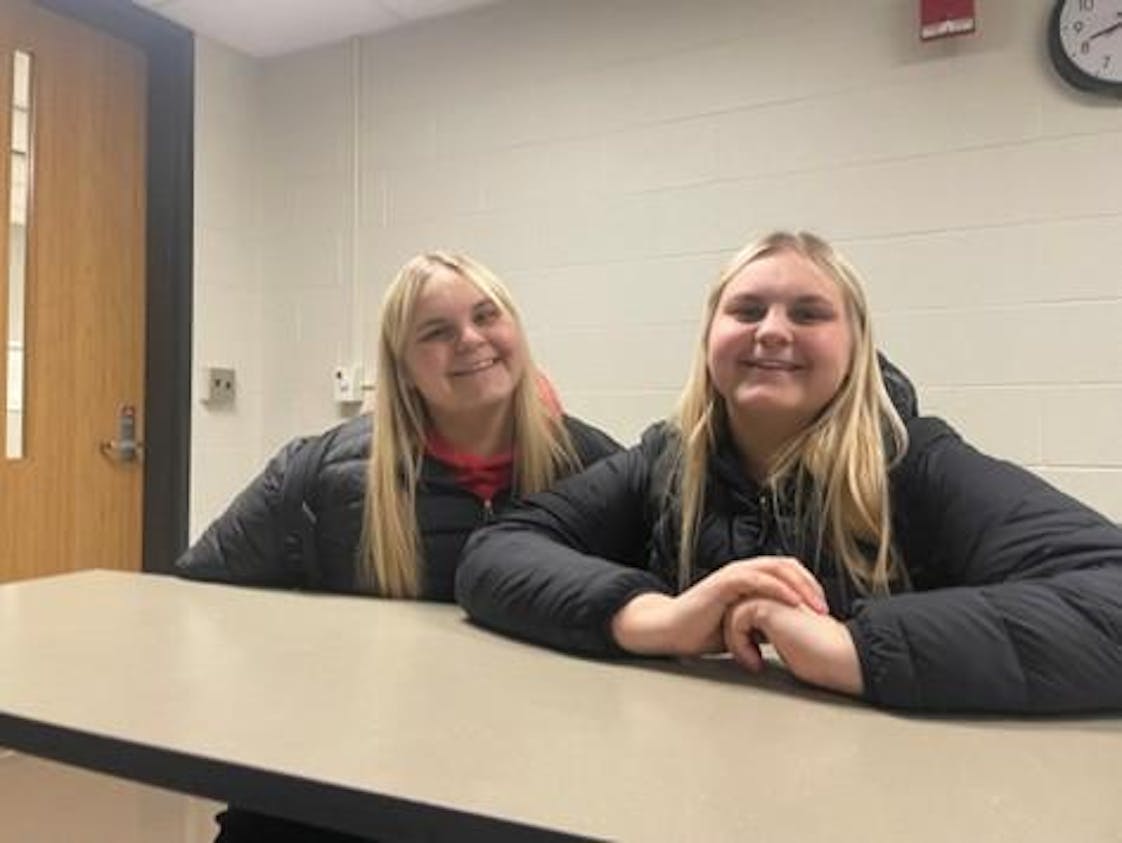
Hannah (right) and Ella Schultz are twins from Billings, Montana, attending Eastern Michigan University as freshmen studying journalism and media studies.
EMU outreach efforts
Russell said that to recruit out-of-state students, EMU hosts bus trips to bring students from areas with student interest, participates in college fairs, goes on specific high school visits, and reaches out to community-based organizations who work with students every day.
“There has also been a strong media presence through billboards, through newspapers, through magazine that the university has done to make sure that students are aware of us as an option on a reading level in addition to our personalized visits or one-on-one visits,” Russell said.
Russell added that there have been efforts to relay to students the message that all are welcome here.
There are plenty of reasons students might choose to attend college out of state. Hannah Schultz said she wanted to go out of state to experience something different than Montana, and she’s always liked Michigan. Ella Schultz said she wanted to get away from kids at her high school, and she thought that it would be nice to be independent from her parents.