

Editor's note: The Eastern Echo staff meets
regularly with interesting people on and off campus. Engage in those
conversations with us through our Q&A reports.
Toni Pressley-Sanon, a professor of Africology and African American Studies at Eastern Michigan University, became the interim department head in January 2026. At the University of Wisconsin, her doctoral work focused on African languages and culture. Her staff profile states, "Her work dwells on the intersections of memory, history and cultural production in both Africa and the African diaspora." In her recent book, "Lifting as They Climb: Black Women Buddhists and Collective Liberation," she reflects on her own experiences with the intersection of Buddhism and race.
Pressley-Sanon sat down with The Echo on Feb. 10, 2026, to discuss the past, present and future of Africology and African American Studies at EMU.
Q: What does your day-to-day life look like in this job?
A: Right now, it looks like a lot of learning about different systems in the university. It looks like getting to speak with students about their schedules, but also about their lives and their aspirations. It means getting to work with amazing faculty. It means potentially being able to work with other departments to offer really great courses for our students. It also entails creating a sense of community in the department.
The department was founded at a time of political unrest during the Civil Rights Movement and the Black Power movement. It was created out of a sense of a need for an education of liberation. And it was very much community-based, so it's very important for us to keep that spirit of community engagement alive. So small gestures, celebrating people when they have accomplished something, I think, go a long way. It is not easy to thrive in these environments very often, and creating opportunities for people to come together around food, snacks or music, it helps to create a sense of community. I've been working really hard to do that, along with my colleagues, so that's been fun.
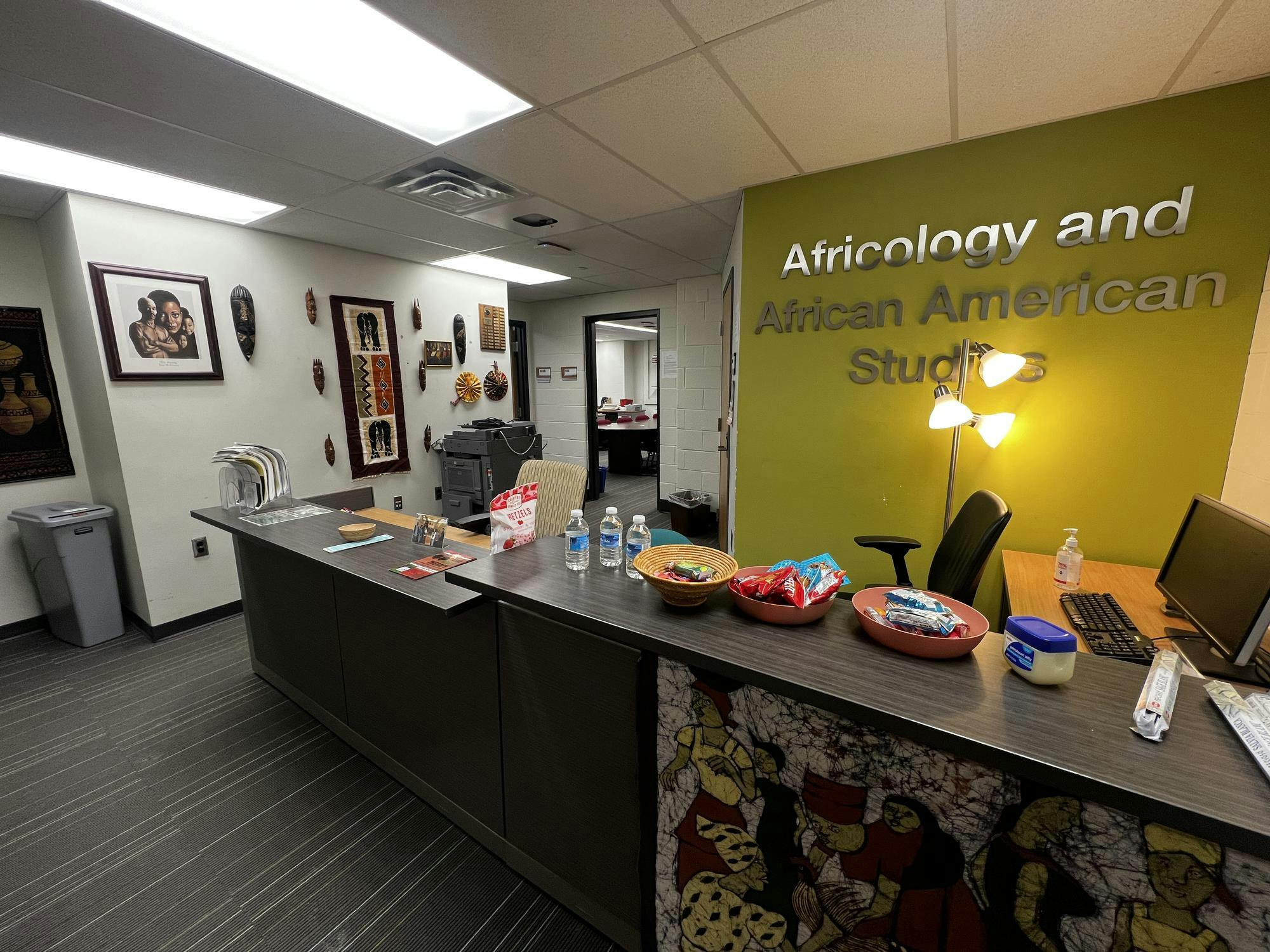
The Africology and African American Studies department, located in room 620 of Pray-Harrold, on Feb. 10, 2026
Q: Could you talk about what the history of Black studies at EMU looks like?
A: It is a long, long history; we've been here since 1975. It came out of student protests, along with the support of many faculty members. It was part of a larger effort across the country to bring Black studies to university campuses as a result, in part, of more students of color being admitted to universities. People wanted to see themselves reflected in the curriculum. They wanted to see faculty members who looked like them. This was part of a larger push for students to see themselves reflected in what they were being taught, as well as who was teaching them.
EMU was definitely part of that trend. In fact, the "Study and Struggle" exhibit reflects that history where students of all colors were protesting, leaving class in order to join the struggle, writing editorials, just doing all kinds of really amazing things to support the movement forward for Black studies.
The department is very interdisciplinary. My graduate work is in African languages and literature with a minor in Caribbean, Latin American and Iberian studies. We have someone from history, someone from sociology, political scientists, so it is very much interdisciplinary. I think that's part of what makes it very, very special, is that we are able to pull all these different disciplines together to look at the African and African diasporic experience.
Q: What themes or issues accurately represent what that looks like here at EMU?
A: I would say most of all, we would not be here without student activism. It's really important to understand and remember how important students are for us to be able to do what we do. The reason that the department was even founded was because of student protests and student agitation, student interest. It's really our job to follow the lead of students, because honestly, they're the ones who will take us where we need to go. I think that's what's always forefront in my mind. I also am very committed to, "I am because we are," which is a longstanding African principle, that we stand on others' shoulders, and others stand on our shoulders. Basically, we need each other; our fates are intertwined, and we can definitely see this in the origins of our department as well as in the future of the department.
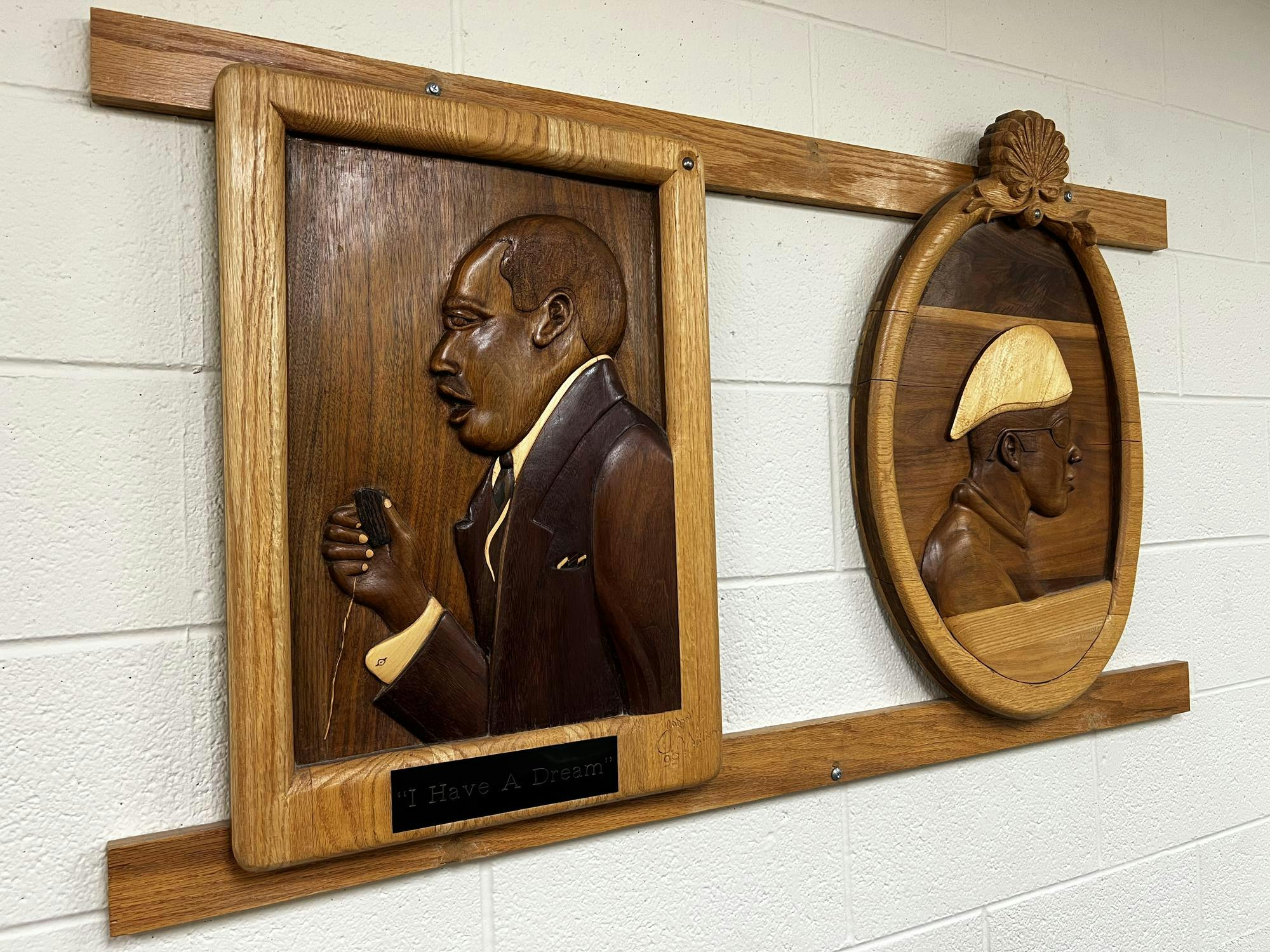
Wooden engraved art is displayed on the wall in the Africology and African American Studies department at Eastern Michigan University. The late Rev. Dr. Martin Luther King Jr. is depicted on the left. Interim Department Head Toni Pressley-Sanon told The Echo that the depiction on the left is of "an unnamed young African American man, symbolizing, among other things, that anyone can achieve the greatness of Martin Luther King, Jr."
Q: When you say the creation of the department was supported by protests, what does that look like?
A: Those original protests were part of a national movement for students to see themselves reflected, both in the curriculum and in the people who are teaching them. For most of our history, our contributions have been written out of history. You have people like W. E. B. Du Bois, who was really committed to bringing African American studies to publishing and academia. You have African Americans who have founded universities; we've always understood that education is power.
I believe that those people, those students from the 1960s who were protesting, who were agitating, were carrying on a legacy from the slave era: people who understood that literacy was power. So this is all part of a longer history. You have that 1960s moment that goes into the 1970s, when we got our department.
Over the years, there have also been instances of racist aggression on campus. When I came to campus, there were several horrific racist incidents on campus, and there was massive student uprising or protest. Several students actually occupied the student union. It was a very difficult time. Out of those protests, students came up with a 10-point plan, and part of it was the demand that our department have a master's program. So we developed it and got it approved by the Board of Regents. There is some painful history around where we are now, but we also understand that these are the origins of our department as well. So it's not new to us.
Q: Could you speak more to what the sense of community looks like outside of the department, and in general?
A: I think that Ypsi is really special. There's a sense that people will look out for each other in this area. There's a long African American history here. I love that we have so many local businesses. We have a Black-owned bookshop, we have Black-owned stores here that we can support. I feel like this is a place where people of color feel like they can thrive. I think EMU has a lot to do with that.
I do know that in the early part of the history, the students of EMU used to go into the community and serve breakfast, which is something that the Black Panther Party used to do. So we do have that history. One of the things that I'm working on as department head is re-establishing some of those relationships. I'm planning to go to a local high school and talk with students about African American sculptors, for example. I think our presence in some of these other spaces is really important so that they know that EMU was there for them as much as they are here for EMU.
I've been really deliberate about making sure that we share events that are happening on campus at the library, at the bookstores, at the coffee shops in town, because I really want to bring more of the Ypsi community into EMU spaces and vice versa. So I am, like, beating the drum for faculty to venture out into Ypsi and to be part of the community. I mean, we wouldn't be here without this community, because most of our students come from the immediate environment or Flint and Detroit. So we really need to continue to establish our relationship and build our bond.
Q: It sounds like you interact a lot with students in your role. Would you say that's true?
A: I would say less so than I used to, in part because so much is online now. I don't get to spend as much time with students as I used to, but I think the more the students learn that I'm here, the more they come and visit me. I've had several students come and sit in my office and have tea with me or have some chocolates, and we just talk about what's happening and their lives, and it's absolutely lovely. I think it's really important to provide spaces like that for students. It's not always about school. We have some amazing students here: artists, activists and historians, so I find them incredibly fascinating, and I love talking to them.
Q: In talking to those students, what would you say are the struggles that Black students face on campus today?
A: I think at one point, our university was referred to by certain people as the HBCU (historically Black college or university) of the Midwest. Because even though this is a PWI (predominantly white institution), I think there was a real sense of ownership of the university. I think COVID changed a lot of everything.
I don't know if I can be 100% sure when I say this, but I do think that there is still, especially in certain classes, a sense of alienation or of sticking out like a sore thumb. I think this is probably not the case for classes in our department, but I have spoken to students who have experienced people not wanting to work with them on group projects or with lab projects or experiencing microaggressions. I think more than anything, it's the microaggressions from other students and from sometimes even faculty members that are the most frequent, the most difficult to prove, and sometimes even the most harmful, because you are left wondering, did that happen, or were they just having a bad day? Or, is it my imagination, or am I reading into it? You know, all of the gaslighting that people experience comes up during those interactions. I think it can make it very difficult to do the work that you need to do when you have to constantly be vigilant about what someone is going to say or do. Not to even mention making their way to campus, what kinds of things can happen — someone cuts you off, calls you the N-word, or some other aggression that you may not even feel like you can talk about in certain spaces. Unfortunately, this is something that our students have to continue to deal with, even 50 years after we established this department.
I think that one of the reasons that a department like ours is so important is because part of our work is bringing these kinds of issues to the fore and giving them historical context, being able to talk about them, helping students understand or contextualize what it is that they're experiencing, right? So they can educate others, and it may actually end up being a site of study for them, to take something that was meant to harm them and actually turn it into a learning opportunity. And in that way, of course, what it is that we're doing is liberatory, because you're not just sitting in the pain. You're actually turning it into something that is useful or educational for not only yourself, but for others.
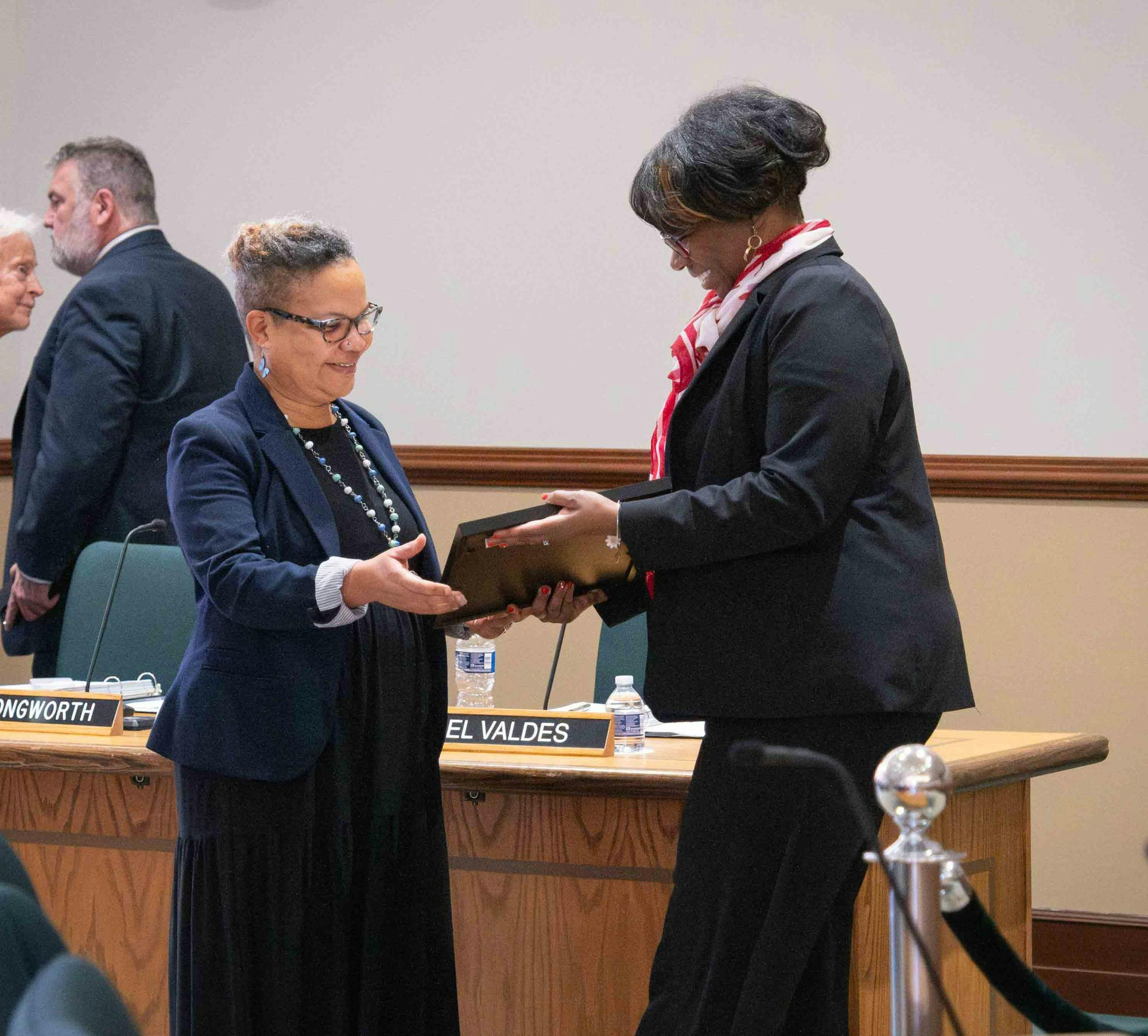
Eastern Michigan University Regent Jessie K.W. Kimbrough presents Toni Pressley-Sanon, interim department head and professor of Africology and African American Studies, with an award for recognizing the department's 50-year anniversary at the Feb. 12, 2026, Board of Regents meeting.
Q: Do you know if the federal initiatives against, specifically, DEI policies in schools, have affected us here at Eastern?
A: We've never discriminated against anybody. Anybody who's interested in Africology and African American studies is welcome to come to class.
I think the way that certain programs have been targeted is really unfortunate. For example, McNair, with this specious belief that it is only for students of color, which is not true — it's for first-generation students as well. I think that in some ways, there's a basic misunderstanding of who these departments and programs really support. The fact is that African American history is American history. There's nowhere in this country's history where there are not people of African descent. I think the work that we're doing is really important in terms of bringing the full picture of the United States to light in all of its beauty and all of its ugliness.
Q: Has there been pressure from the government to whitewash the curriculum here recently?
A: Just in my conversations with colleagues, I haven't gotten the signal that we've been under direct attack.
Q: Where do you see, or where would you like to see, the department go from here?
A: I've got big hopes for the department. I think it's vitally important to our student population. I think it's vitally important to the university. I think it's vitally important to our society at large. It's really, really important to be able to have open, respectful conversations about how we got where we are, why this history is still important, and how we cannot really envision a different future if we don't know where we've come from. I know there's always this rhetoric about leaving the past in the past, but we have to understand that the reason we are in this position today is because of what's happened in the past.
I think what our department does is an incredible service to humanity, and anybody who wants to interact with the department to really engage in deep conversation around some of these issues that are incredibly prescient today, have been in the past, and will be in the future. I think that comes from a history of community and a history of care. It's not only what's being taught, but also how it's being taught. It's really, really important. My big hope is that we will be able to grow the department, that as many people as possible will be able to take advantage of what it is that we have to offer, which is immense. The more that people engage, the more we can envision something better, something bigger and something grander. And so my hope is that this 100th anniversary of Black History Month, this 50th anniversary of the department, is the beginning of a hopeful new chapter in our department, and in the university at large, with the department integral to the university.


