

If the packed room at a town hall last Thursday was any indication, there is growing fear about immigration enforcement in Washtenaw County.
That's what Washtenaw Board of Commissioners Chairperson Katie Scott said when she addressed the crowd of people, who filled nearly every seat in the room to hear an update about immigration from the Washtenaw County Sheriff's Office Feb. 5, 2026.
"When a room fills like this one, it tells me that people are scared and angry," Scott said.
Laura Sanders, an advocate for the group Movement for Immigrant Rights Action, told The Eastern Echo that the group receives weekly and sometimes daily reports of Immigration and Customs Enforcement activity in Washtenaw County.
With increased immigration enforcement crackdown occurring nationally, Michigan and Washtenaw County advocates, legal experts and elected officials, including U.S. Rep. Debbie Dingell, joined together to provide updates, review rights and dispel misinformation.
Below is a guide to federal immigration enforcement, takeaways from the town hall and resources for impacted community members.
Federal vs. local law enforcement
In the United States, immigration enforcement is primarily a function of the federal government. Federal immigration enforcement agencies, including Immigration and Customs Enforcement and Customs and Border Protection, fall under the U.S. Department of Homeland Security.
Other federal law enforcement agencies include the Federal Bureau of Investigation, the Bureau of Alcohol, Tobacco, Firearms and Explosives, or ATF, the Drug Enforcement Administration and others.
Statewide, Michigan State Police policy prohibits officers stopping, questioning, arresting or detaining anyone suspected of violating federal immigration law solely on the grounds of their immigration status, alienage or individual personal characteristics.
Local law enforcement, which includes county, township and city police departments, enforce local and state laws.
In Washtenaw County, local law enforcement officers do not investigate people’s immigration status, County Sheriff Alyshia Dyer said at an immigration update town hall. Washtenaw County policy prohibits employees from profiling individuals, saying that suspicion of undocumented immigration status is not a reason to take investigative action.
“Employees shall never ask about an individual’s immigration status when performing their duties. Any activity regarding law enforcement shall be based upon reasonable suspicion or probable cause supported by clearly articulated facts and circumstances not relating to immigration status,” county policy states.
In Ypsilanti, the City Council passed a “don’t ask” ordinance regarding immigration status in 2017. A Jan. 28, 2026 Facebook post from Ypsilanti Mayor Nicole Brown reaffirmed that the city, including the police department, does not enforce or assist in civil immigration enforcement.
“Our local police and city staff do not ask about immigration status, do not enforce federal immigration law, and do not assist ICE with civil detentions,” Brown said in the post.
The Eastern Echo submitted a request for interview to ICE on Feb. 3, 2026, and did not receive a response at the time of publication.
Identifying federal agents
At the immigration town hall, Dyer provided tips to community members to differentiate between local and federal law enforcement.
Local law enforcement usually has the name or logo of the local agency displayed on the vehicle or uniform, Dyer said during a presentation.
Washtenaw County police officers typically display their name, a badge, the Washtenaw Sheriff insignia, and carry business cards, Dyer said.
ICE agents might dress in plainclothes or display Police HSI or Police on their clothing. These officers might carry ICE or Homeland Security Investigations credentials and usually drive an unmarked vehicle, Dyer said.
Laura Sanders, a local advocate with the group Movement for Immigrant Rights Action, said many ICE agents also wear camouflage uniforms and military-style green garb, as well as plainclothes. She said they are often masked and armed with weapons and other gizmos.
Dyer warned that if a police officer is wearing jeans, that doesn’t necessarily mean they are ICE; typically, county detectives wear plainclothes, but they usually wear a lanyard displaying their badge or a vest that says Sheriff.
If approached by law enforcement and unsure if it is federal or local police, community members can call the Washtenaw County dispatch to help verify, Dyer said.
“If there is uncertainty about if it is us, or local law enforcement, or if it is federal, you can always call dispatch and they will be able to tell you if us and local law enforcement are there for a reason; and if we are there, it is separate from immigration enforcement,” Dyer said.
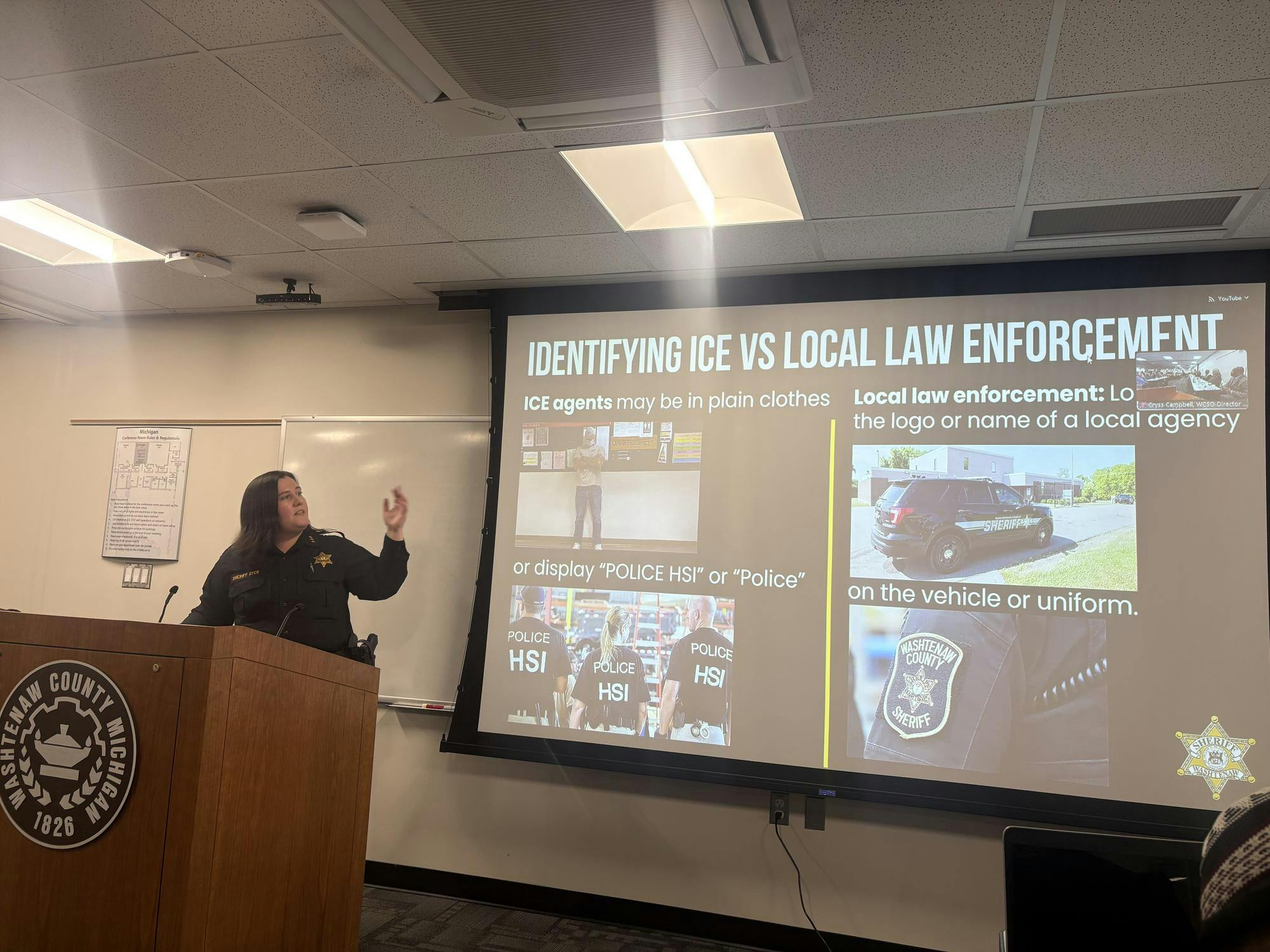
Washtenaw County Sheriff Alyshia Dyer explains how to differentiate between Immigration Customs and Enforcement officers and local law enforcement during a town hall hosted by her office, Feb. 5, 2026.
Anyone has the right to ask for identification from agents if approached by law enforcement, including the department they are from, their name and their ID number, Rebecca Olszewski said. Olszewski is a managing attorney at the Michigan Immigrant Rights Center and led a presentation about immigration rights at the town hall.
Dyer also cautioned against making assumptions without verifying information, which can cause more harm than good to the community. Not every tinted vehicle belongs to an ICE agent, Dyer added.
Community resources
There are organizations in Washtenaw County and Michigan that can provide support to immigrants in the area.
The Washtenaw Interfaith Coalition for Immigrant Rights is a local, volunteer-run group that provides services including urgent response to immigration emergencies, education, political action and more. Contact WICIR’s emergency hotline at 734-355-2707.
The Movement for Immigrant Rights Action is another group in the area, focusing on community education, police advocacy and policy work with local elected officials. MIRA also tracks ICE sightings in the community. Reach MIRA at 734-224-3852. Sanders said for community members looking to get involved in advocacy, the MIRA website is a good place to start.
"I think that getting active and helping to track and witness and protest and resist ICE enforcement in our community is important and it is what allies should do," Sanders said.
The Michigan Immigrant Rights Center is a legal resource center for immigrants, providing information about immigration rights, pro bono legal services on a case by case basis, referrals and online guides for navigating immigration court, detention and more. For general immigration services and information, call MIRC at 734-239-6863, 10 a.m. to 4 p.m., Monday through Friday.
If you see immigration officers
If you see ICE activity, do not approach, obstruct or intervene, Dyer said in the town hall presentation. Physical proximity or confrontation can escalate risk, she added. Instead, community members can observe, photograph or record from a safe distance in public areas, Dyer said.
Michigan Attorney General Dana Nessel’s office recently launched a tracking form to report concerning immigration action. Reports can be made anonymously and residents are encouraged to share video links and photos, a statement said.
“In Michigan, we do not, and will not tolerate harmful, illegal actions against our residents, and I will not hesitate to uphold the law. That includes investigating unlawful actions perpetrated by a federal officer in our state. This new form allows Michiganders to report alleged misconduct right to my office,” Nessel said in a statement.
Washtenaw County residents who wish to report ICE activity or sightings can also do so using the MIRA hotline at 734-224-3852.
However, community members should use the SALUTE model when reporting ICE activity, Dyer said. SALUTE stands for Size: the number of officers, vehicle or individuals; Activities: what is occurring; Location: exact address, intersection or clear description; Uniform: clothing, patches, markings and logos; Time: specific time of activity; and Equipment: vehicles, weapons or special gear.
“Accuracy protects individuals in the broader community,” Dyer said. “When in doubt, we always say to verify, use trusted channels, and — I can’t say this enough — if you are going to do any work around organizing or supporting our immigrant community, lean on MIRA, lean on WICIR; they really have the expertise on how to handle the situation.”
If approached by immigration officers
If ICE knocks on private property, residents do not have to answer the door, Dyer said. If there is uncertainty about whether the officers at the door are local or federal police, you can call 911 to request verification; if it is local police, dispatch can confirm.
Law enforcement can only enter a private space if they have a judicial warrant, which is a warrant signed by a judge, or if they are given permission, Olszewski said during the presentation. Opening the door, even a little, can imply consent for officials to enter the space, she added.
The entire household, including children, should know the plan for responding if ICE comes to the door, Olszewski said.
Everyone has the right to remain silent, the presentation said. You don’t have to give information about your immigration status or where you were born, but you should not say you are a U.S. citizen if you are not or show false documents, Olszewski said in the presentation.
If you have documents that show your right to be in the U.S., always keep them with you, Olszewski said during the presentation.
“As a lawyer, I think it is always good to carry identification with you,” Olszewski told The Eastern Echo. “A person can get … a passport card; you don’t have to carry your whole passport, but you have proof of your U.S. citizenship on you. I think it never hurts these days, and more identification is sometimes safer.”
If approached by officers in your car or while driving, find a safe place to stop the vehicle as soon as possible, Olszewski said. She advised community members to stay in the car, turn on interior lights, open the window and place hands on the steering wheel. You should show your license, registration and insurance to the officer, but do not show false documents, Olszewski said.
Police need a warrant to search a car unless they have probable cause to believe it contains evidence of a crime and you have the right to not consent to a search.
If approached on the street, ask if you are free to leave; if the officer says yes, you can walk away calmly, Olszewski said in the presentation. You also have the right to tell the officer that you decline to continue answering questions at any point.
“If, for whatever reason, they are trying to detain you, we ask that you do not resist, because we want you to get through that situation alive and fighting in the moment is never safe,” Dyer said.
At workplaces, employers have the right to not consent to officers entering private areas.
While knowing your rights is important, community members should also be aware that ICE often ignores those rights, so it is important to understand the risk, Sanders said.
"They are violating people's rights as a rule, as a norm; it is not the exception," Sanders said to The Echo.
If you feel your rights have been violated, the best thing to do in the moment is not to obstruct or interfere with law enforcement, which could result in further arrests or problems, Olszewski said to The Echo.
"The best thing in the moment is to stay as calm as possible," Olszewski said. "Make sure you communicate with family members or friends, communicate any emergency aids that you might have, but I believe fighting would amplify the situation and perhaps cause harm or further charges, so not obstructing law enforcement is the best approach."
Warrants and detainers
There are multiple kinds of warrants that an immigration officer could present. A judicial warrant is one that goes through a court and is reviewed and signed by a judge. State and federal courts can issue judicial warrants, stated a guide from the National Immigration Law Center.
An administrative warrant, typically issued by DHS, is not reviewed by a judge and is only signed by an immigration officer. A warrant signed by an immigration judge is not a judicial warrant, the NILC guide explained.
A judicial warrant has more power and allows a search under the Fourth Amendment, Olszewski said.
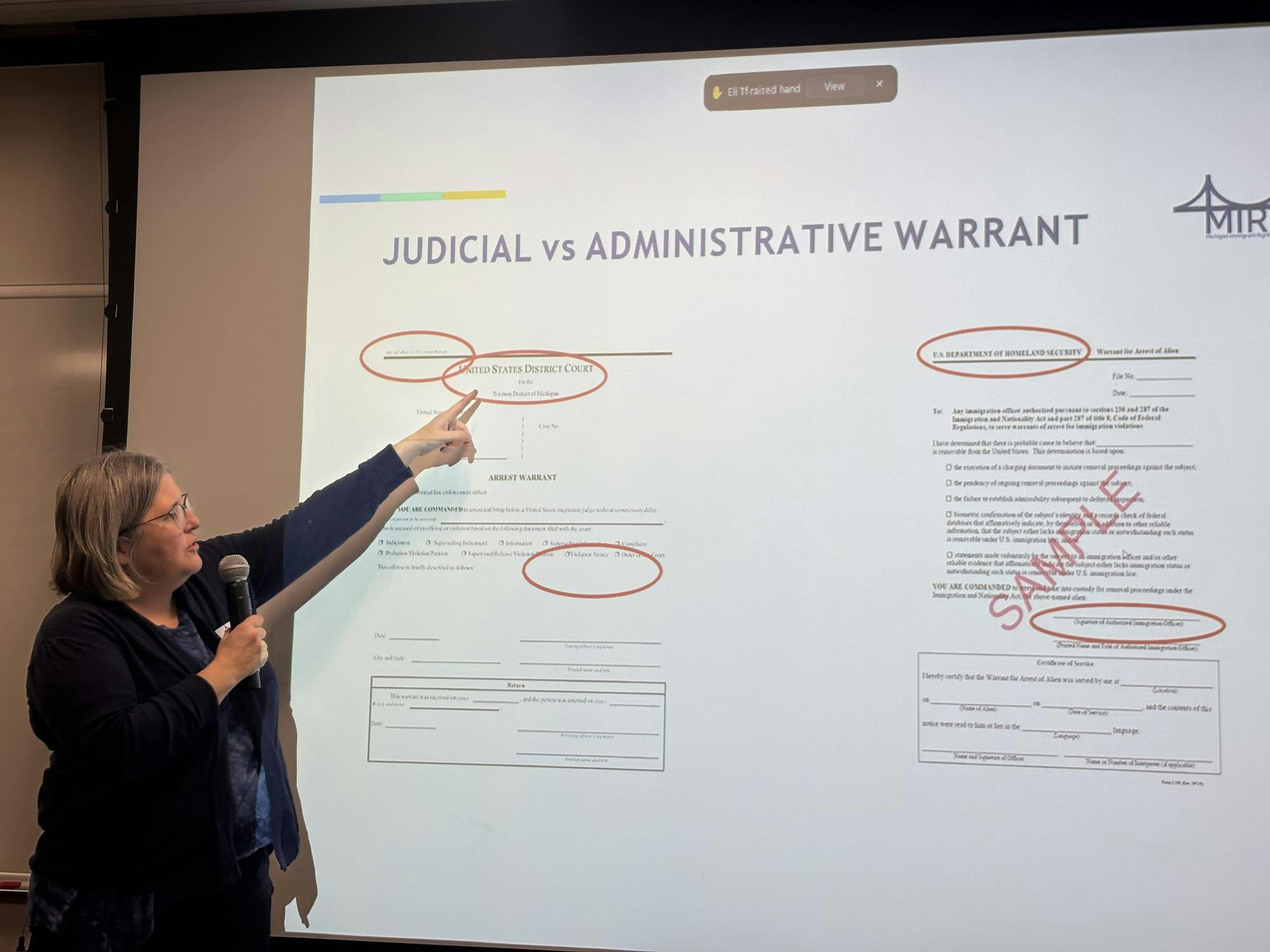
Rebecca Olszewski, managing attorney at the Michigan Immigrant Rights Center, explains the difference between a judicial and administrative warrant at a town hall hosted by the Washtenaw County Sheriff's Office on Feb. 5, 2026.
“The big thing is to always look for that judge’s signature,” Dyer said.
An administrative warrant, issued by a federal agency, doesn’t authorize a search, but could authorize an arrest or seizure in certain circumstances, NILC said.
Sanders told The Echo that in her 18 years of immigrant rights advocacy work, she never seen an ICE agent present a judicial warrant signed by a judge.
In Washtenaw County, the sheriff’s office requires a federal warrant signed by a judge to hold a person in its corrections facility, Kurt Schiappacasse said. Schiappacasse, who spoke at the town hall, is the Washtenaw County Sheriff’s Office commander of corrections.
DHS immigration detainers and warrants of removal/deportation are advisory requests to detain an individual, not federal judicial warrants, County Sheriff policy states. The Sheriff’s Office will not detain an individual under an immigration detainer or warrant of removal/deportation issued by ICE and signed by an ICE agent. These documents must be accompanied by a federal court order or warrant signed by a federal magistrate or judge for the county to detain someone, the policy said.
“In the jail, we are not going to detain somebody based solely on the justification of the immigration detainer,” Schiappacasse said. “The Sheriff’s Office is not going to use any type of resources to assist in ICE functions.”
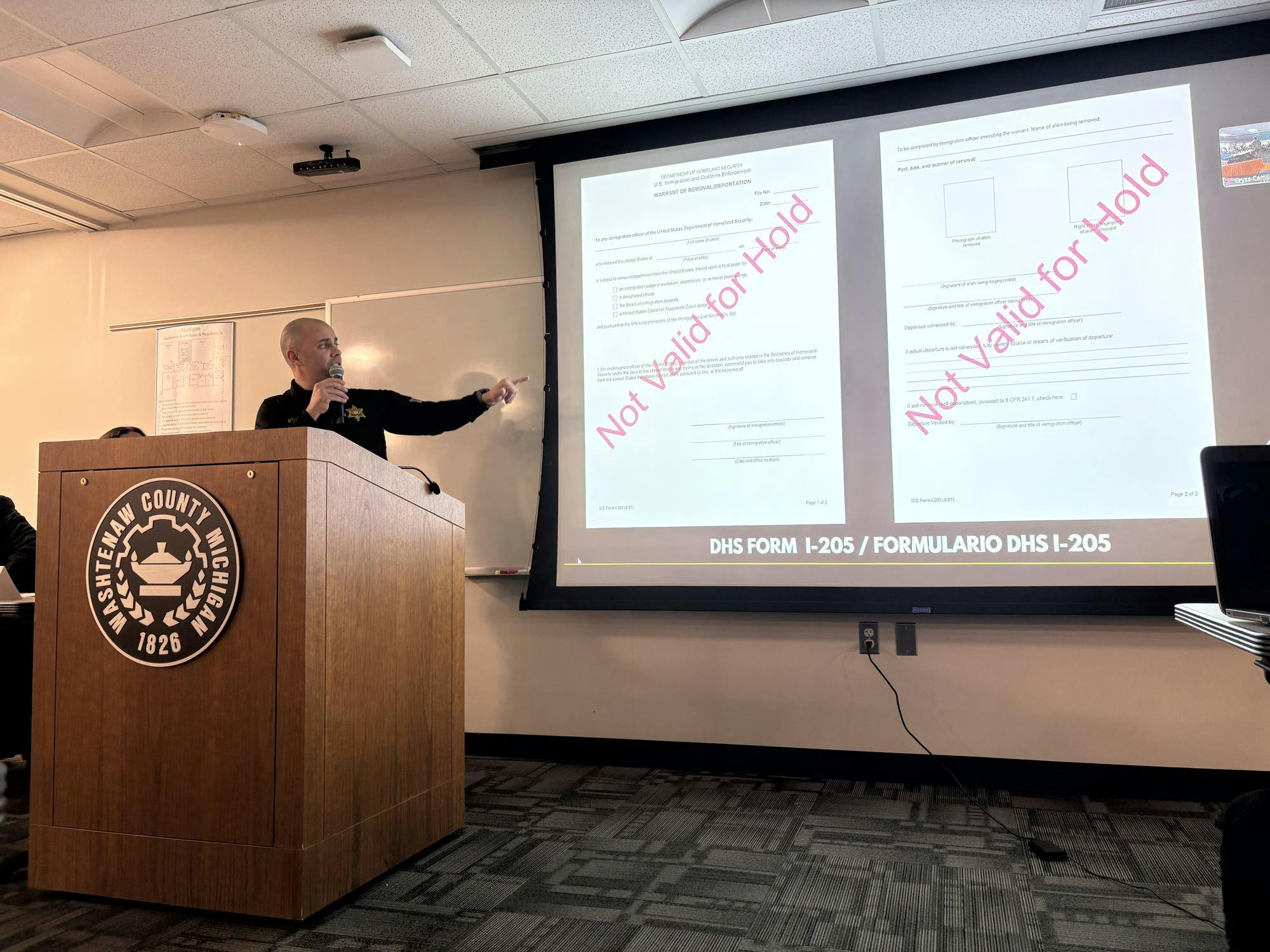
Washtenaw County Commander of Corrections Kurt Schiappacasse explains different immigration detainers and warrants for removal/deportation during a town hall hosted by the Sheriff's Office on Feb. 5, 2026.
If you or a loved one is arrested
If detained or arrested, you have the right to remain silent.
You have the right to know why you were arrested. If you are arrested, ask why you are being arrested, who is arresting you and ask to call a lawyer. Request the name, agency, ID number and telephone number of the officer arresting you. You also have the right to speak to a lawyer.
In detention, you are not required to sign papers you don’t understand, and should consult your lawyer first. You also have the right to tell the officer to inform your consulate of your arrest. You should also ask for bond, so your loved ones can help facilitate your release.
If you are scared to return to your home country, tell that to officers and your attorney.
It is also a good idea to carry documents that provide evidence that you have lived in the U.S. for more than two years, such as postmarked mail to your home, a signed lease or church or school records with your address, the presentation said. That can help avoid an expedited removal if you are detained, which applies to immigrants who have been physically present in the U.S. for less than two years.
To find detainees online, use locator.ice.gov or call 313-771-6601 in Michigan. You can also use vinelink.dhs.gov.
Make a plan
Olszewski advised people at risk of immigration-related detainment to put a plan in place, especially if they have children.
You should find a trusted person to care for your children if you are detained, to avoid temporary custody by Child Protective Services, the presentation said. Make sure that trusted person is your emergency contact.
The presentation advised preparing a Delegation of Parental Authority, which is valid for six months and doesn’t require notarization for use in Michigan. To prepare one, visit michiganimmigrant.org, michiganlegalhelp.org or ayudalegaldemichigan.org.
Protests and rallies
The First Amendment protects the people’s right to peaceful assembly and protest in public spaces.
For community members planning protests and demonstrations, Dyer advises coordinating with local law enforcement in advance when possible, to help reduce safety risks and disruptions.
She suggested designating a police liaison — someone who feels comfortable communicating with law enforcement — as a point of contact if issues arise. Local law enforcement can assist with traffic control, prevent agitators or people with ill-intent and keep people safe, Dyer said.
“Our goal is safety, keeping everyone safe, protecting people’s constitutional rights to protest,” Dyer said. “We have had many rallies and many protests throughout Washtenaw County. We have not had issues. People have been peaceful. People have been respectful.”


