

In today’s political climate, freedom of speech is a hot topic, especially on college campuses.
The Foundation for Individual Rights and Expression, or FIRE, is a nonprofit civil liberties group that focuses on freedom of speech. Its website explains that its mission statement is to “sustain individual rights, educate Americans on free speech, and promote a culture of respect for these rights.” FIRE originally started in 1999 as an organization to serve colleges, but in 2022, it branched out to protect freedom of expression for a broader society.
FIRE regularly conducts surveys to determine how well U.S. universities uphold the First Amendment. After surveying over 68,000 students from more than 250 colleges and universities, FIRE released its 2026 rankings.
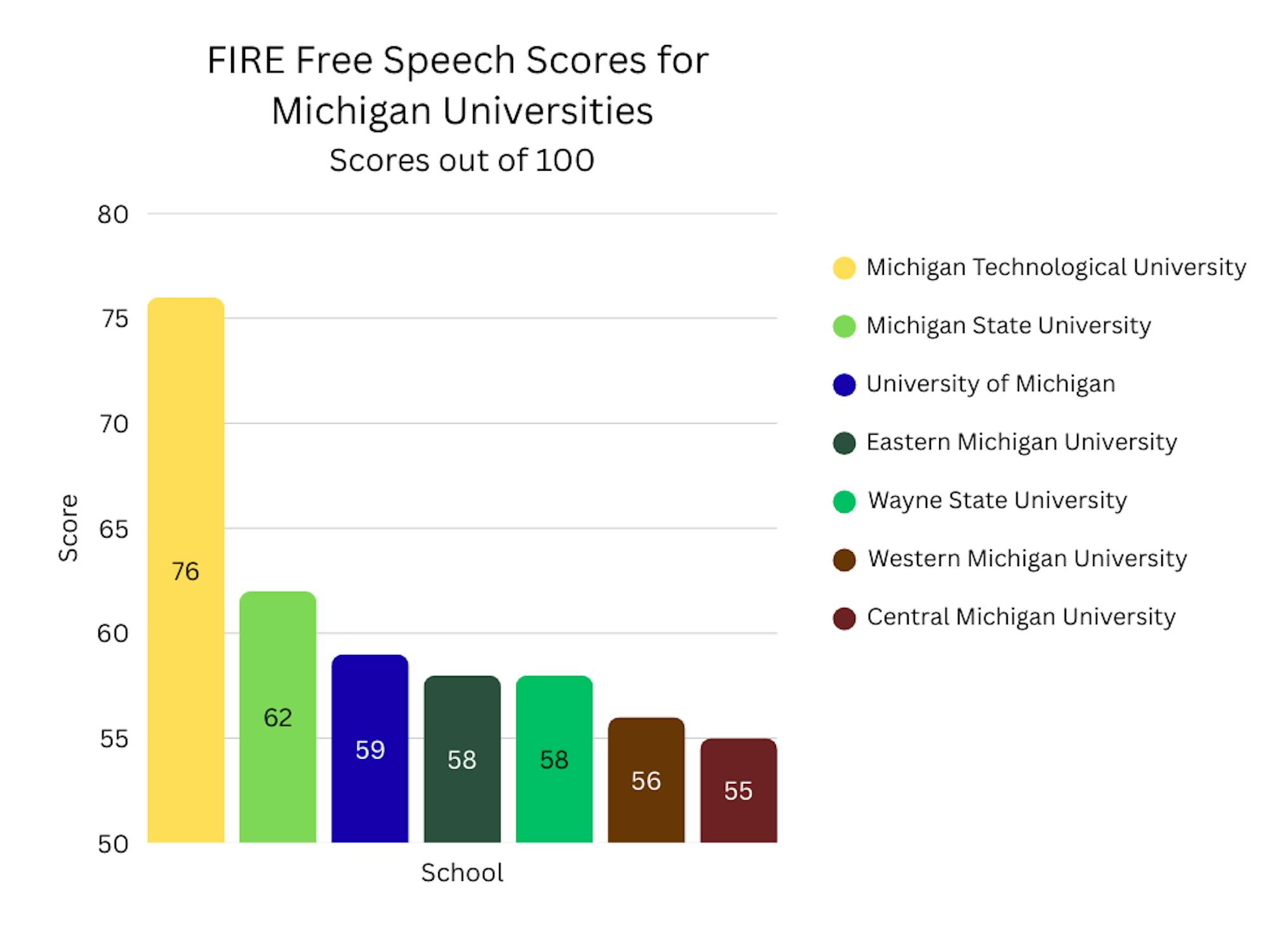
Eastern Michigan University ranked 122 out of 257 schools, dropping 33 ranks since 2024. FIRE explains the ranking process as a comparison of 257 U.S. colleges and universities on free speech, based on overall scores from student surveys, campus policies, and speech-related controversies.
For a university’s overall score, EMU received a 57.9 out of 100 for how open and supportive the campus is for free speech. This is a 0.7-point increase from 2024. This score is also determined by student surveys, campus policies and speech-related controversies. The score is placed on a standard grading scale, earning EMU the failing grade of an F.
Eastern had zero reported speech-related controversies. FIRE defines speech-related controversies as “campus incidents where a student, professor, or speaker faces backlash or pressure for speech that’s protected by the First Amendment of academic freedom."
Jack Booth, a business student and the Student Government president at EMU, told The Echo, "I believe that free speech is important on a college campus, because a university should be a place where ideas can be explored and challenged without fear. Open dialogues that emphasize free speech help to strengthen critical thinking while preparing us to participate in a diverse and democratic society."
How do other universities rank?
EMU’s closest neighbor, the University of Michigan, ranked slightly higher: 105 out of 257 schools. However, it also received an F with a score of 58.6. U-M had three reported speech-related controversies.
Central Michigan University is one of EMU’s closest competitors, being nearby and comparable in size. CMU ranked 188 out of 257 schools, with a score of 55.2 and one reported speech-related controversy.
Western Michigan University also ranked lower than EMU at 168 out of 257 schools. WMU received an F with a score of 56.0.
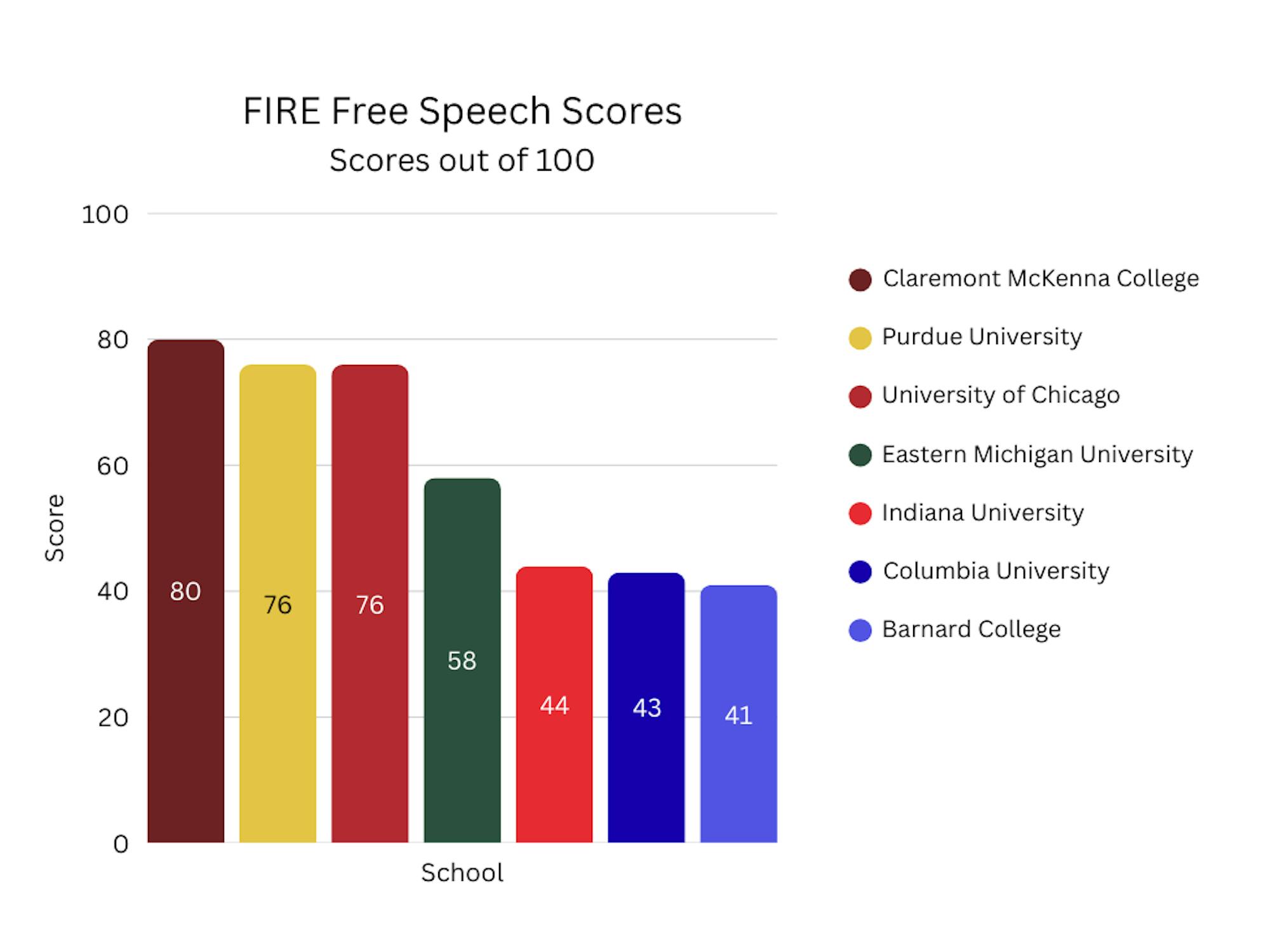
The top-scoring universities in the country were Claremont McKenna College, Purdue University and the University of Chicago.
Ranked best in the country, Claremont McKenna College, a private liberal arts college in California, earned a B- with a score of 80 out of 100. Purdue University and the University of Chicago tied with a score of 76.
The lowest-scoring schools in the U.S. were Barnard College, Columbia University and Indiana University. Indiana University scored a 44, Columbia University scored a 43, and, worst in the country, Barnard College scored a 41 out of 100.
What speech is protected under the First Amendment?
Freedom of speech is a First Amendment right, but the U.S. court system has struggled in the past to draw clear lines of what is and is not covered by the amendment. The United States Courts website states that freedom of speech includes the following rights:
- “Not to speak (specifically, the right not to salute the flag).
- Of students to wear black armbands to school to protest a war ('Students do not shed their constitutional rights at the schoolhouse gate.').
- To use certain offensive words and phrases to convey political messages.
- To contribute money (under certain circumstances) to political campaigns.
- To advertise commercial products and professional services (with some restrictions).
- To engage in symbolic speech (e.g., burning the flag in protest).”
All of the previous statements have been verdicts found in the federal court system. Visit the United States Courts website for more details.
FIRE's website explained that certain narrowly-defined types of expression are not protected by the First Amendment. These types of speech include the following:
- Incitement, or speech that the Supreme Court defines as "directed to inciting or producing imminent lawless action and is likely to incite or produce such action"
- True threats, defined by the Supreme Court as "those statements where the speaker means to communicate a serious expression of an intent to commit an act of unlawful violence to a particular individual or group of individuals."
- Fighting words, which is speech that tends to incite an individual to respond violently and immediately
- Obscenity, which must meet a three-prong test to be legally classified as such
- Defamation, which is a false statement of fact communicated to a third party, made with a guilty state of mind that harms an individual's reputation
- Fraud and perjury, such as false advertising
- Speech integral to criminal conduct
Universities have some right to limit freedom of expression on campus. For example, rules limiting noise levels or number of people in a designated place after a certain hour, prohibiting blocking doorways, or assuring that public student spaces stay available to all students are all acceptable under the First Amendment.
There are some gray areas that are not inherently included in the First Amendment, giving universities the right to limit these activities. Examples of this on college campuses would be true threats, harassment, incitement to violence and obscenity.
The First Amendment applies only to government interference, and not private censorship, PEN America reported. This means that public and private universities may have different policies regarding freedom of speech and expression, because private institutions have fewer regulations.
Cases of restricted free speech on a college campus concern university policies or punishments related to speech and expression. Self-censorship is the voluntary choice not to share one’s own opinions, knowledge or expressions due to fear or social stigma.
For example, FIRE reported that there are 4.04 liberal students for every one conservative student on campus. If a conservative student felt that they could not share a political opinion in class due to social pressures, this would be self-censorship. If the university did not allow discussing political topics in class, this would be restricted free speech.
Political speech and self-censorship
Many students have noted that in recent years, politics has become a polarizing topic. Syracuse University Today found that the U.S. political climate is the most divided and hostile it has been since the Civil War. Partisan hostility, which refers to having animosity towards members of the opposing party, has nearly doubled since 2016.
The Brown Daily Herald found that nearly 70% of college students choose friends with the same political views as themselves. Students are becoming less and less likely to spend time with others who have differing views. This leads to only having discussions with like-minded people, which can cause beliefs to solidify, and partisan hostility to increase.
At EMU, 36% of students say they have self-censored on campus at least once or twice a month, said survey results from FIRE. Despite this, FIRE's results place EMU in the top 50 for both “Comfort Expressing Ideas” and “Self-Censorship,” which indicates students might feel freer to speak their minds compared to other schools.
Those interested can learn more about specific policies at EMU by reading its free speech and speaker policy, the Student Code of Conduct and policies on gatherings.


