On Oct. 1, 2026, community members stood on the corner of South Huron Street and James L. Hart Parkway wearing shirts and holding signs that read: "No Blue and No Los Alamos Too." Two and a half hours later, they sat in front of University of Michigan officials to voice their opposition of a data center being built in their township.
Held Thursday, the second town hall hosted by U-M took place with the purpose of addressing community concerns about the proposed U-M and Los Alamos National Laboratory data center project planned for a Textile Road plot in Ypsilanti Township.
Outside the Marriott Ypsilanti at Eagle Crest where the town hall began at 5:30 p.m., a press conference and citizens protest was hosted by Leah Mills-Chapman, an Ypsilanti Township resident and community activist. Speakers at the conference discussed a lack of transparency from the U-M Board of Regents, concerns of environmental racism in the location choice of the center, and the involvement of LANL in the project.
U-M Regent Paul Brown spoke at the press conference about U-M's responsibility to effectively communicate about the project and respond to fears and questions about how a data center would affect the community. Brown was the only U-M Regent in attendance at the conference.
"It is inexcusable that the University of Michigan has not spent time in the community, door to door, neighborhood to neighborhood, living room to living room and answered every one of your questions," Brown said in his speech.
The chosen location for the center is on the property next to Bridge Road and Textile Road, less than a mile from residential property and the Huron River. Speakers at the press conference, including Mills-Chapman and Brown, have raised concerns that the project location is just another instance of environmental racism.
"To place this project directly across the street from a low income, Black apartment complex puts an immense burden and a threat onto a historically known marginalized and targeted population of people; this is what environmental racism looks like," Mills-Chapman said during her speech at the press conference.
According to the Washtenaw County Community and Economic Development, Ypsilanti and Ypsilanti Township are rated among the lowest areas for access to opportunity in the county. Ypsilanti Township also has a greater percentage of residents of color than Ann Arbor; the difference is about 15%, according the U.S. Census Bureau.
Ypsilanti Township attorney Doug Winters focused his speech at the press conference on the involvement of LANL in the project. LANL is federal research laboratory led by the U.S. Department of Energy, known for its role in the Manhattan Project and development of the atomic bomb. Winters has described the site as a potential high value target due to LANL's role in national security and nuclear research, a sentiment which LANL has denied.
"As part of Los Alamos' national security mission, some computational research conducted using the facility could relate to nuclear modernization," LANL wrote in a letter to Ypsilanti Township residents. Copies of this letter were available to attendees of the town hall.
If built, 10% of the facility's computing power would be used by U-M while the other 90% would be used by LANL, a fact which has raised concerns about LANL being the primary beneficiary of the project.
U-M hosts second town hall
The town hall began promptly and featured the same panelists as the Sept. 9 town hall. The first 15 minutes consisted of a presentation from project lead Steve Ceccio that was meant to answer questions and provide further information about the project. The presentation addressed questions about the Textile Road location, U-M's partnership with LANL, environmental studies and protections, and the impact on the local community.
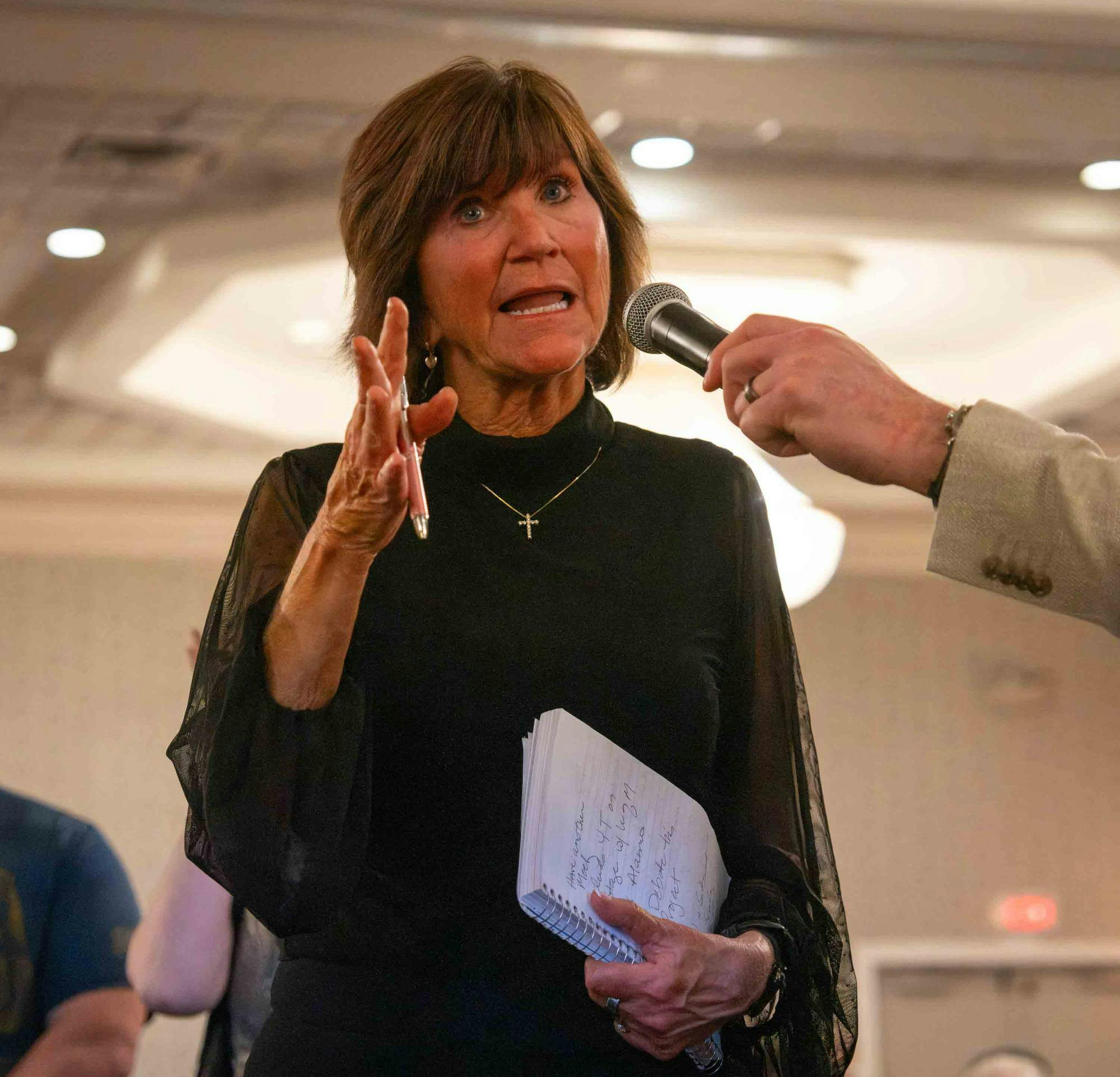
Ypsilanti Township Supervisor Brenda Stumbo addresses panelists during the University of Michigan Oct. 1, 2026, town hall about the proposed data center for a Textile Road plot in Ypsilanti Township.
Ceccio explained that the project as it is planned today would strike the best balance between advancing U-M's ability to compete as a top research university and protecting and providing opportunity to the local community. Attendees in the crowd strongly rejected this idea, with several calling out during the presentation expressing their distrust in the panel. One attendee called out, "Why should we trust you?" followed by another: "We don't trust you."
The next hour and 45 minutes saw a Q&A-style public comment where attendees lined up to address the panel.
Rory McGuinness, a U-M graduate student and resident of Ypsilanti Township, asked the panel why U-M is pushing ahead with the project despite such strong local opposition. He questioned the partnership between U-M and LANL, arguing that U-M investing hundreds of millions of dollars into a project where it will only control 10 percent of computing resources doesn't make sense.
"Why are you misusing the privileges afforded to you under the state Constitution in order to override and negate our right to local self-governance?" McGuinness asked. "We need to know what you expect to gain so it can be weighted against what we stand to lose."
Panelist Drew Smith, interim vice president of finance at U-M, explained that the university would not make money on the project; U-M would finance the project then break even through a rental payment that it charges.
McGuinness wasn't the only speaker to address the panel about local opposition. Carly Hissong asked the panel if U-M would back out of the project if the community continued to oppose it so strongly.
"We know exactly why you picked this community to do it; it's an act of environmental racism," Hissong said after her question went unanswered. The panel thanked Hissong for her comments and moved on to the next speaker.
The last speaker to address the panel was Ypsilanti Township Supervisor Brenda Stumbo. Stumbo asked for another meeting where members of the community don't have to register to attend, like the two town halls. The panel agreed to another meeting that has yet to be scheduled. Stumbo criticized the panel for their lack of transparency with Ypsilanti Township officials and the burden they have put on the community.
"I've wanted to beg you, but I've already tried that," Stumbo said during her comment. "I've already tried begging. So we're gonna fight."